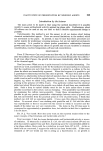
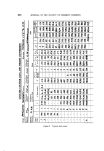
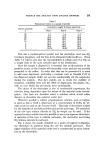
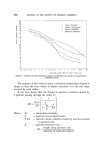
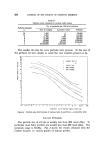
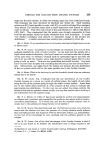
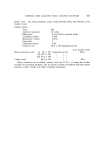
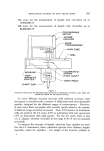
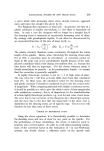
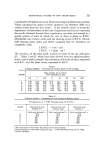
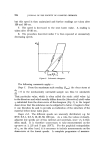
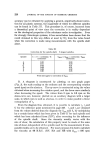
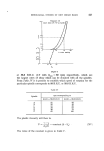
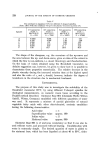
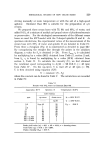
RHEOLOGICAL STUDIES OF NEW CREAM BASES 231 RESULTS The results of our rheological measurements presented in Tables VII and VIII show that the plastic viscosity of the o/w emulsion cream bases decreases with increasing water content. The values of plastic viscosity are independent of the size of the T-shaped spindles used for each sample Table VIII Calculated values from rheograms Sample Spindle 'rs 'rf U ratio •rs/'rf 1 (75%) B 4414 B.S.U. 2347 53.8 P 1.88}2.6 I (75%) E 3462 B.S.U. 1037 B.S.U.
B.S.U. 50.7 P 3.33 II (80%) B 3334 1076 35.9 P 3.10}2.7 II (80%) E 2597 B.S.U.
B.S.U. 1157 B.S.U.
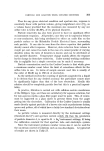
B.S.U. 35.7 P 2.24 III (88%) B 1864 B.S.U. 782 B.S.U. 24.9 P 2.30'1.2. 4 III (85%) E 1731 B.S.U. 710 B.S.U. 23.9 P 2.44f -rs = static yield value -rf ---- yield value U = plastic viscosity. B.S.U. (Brookfield shearing stress units) = 1 dyne ß cm -2. P (Poise)' 1 Poise = 1 g. cm -•. sec -1. within the limits of reproducibility of the method. The experimental values of Table VII show that the cream bases investigated are thixotropic. We can confirm the results of Fryk16f that the Brookfield viscometer with T-shaped spindles is suitable for measurements on plastic systems, e.g. pharmaceutical and cosmetic ointments and creams using his suggested method (1). (Received: 74th September 7965) REFERENCES (1) Fryk16f, L.-E. Svensk Farm. Tidskr. [15, 753 (1961). (2) Green, I-t. Industrial Rheology and Rheological Structures 50 (1949) (New York). DISCUSSION MR. P. S•ERMA•: I am a little puzzled at your choice of the Brookfield viscometer because you so rightly point out that the geometry of the spindle is such that it is almost impossible to calculate absolute values of stress or rate of shear. In the method developed by Fryk16f you make the basic assumption that the flow pattern around plastic systems is exactly the same as for liquid systems this is completely untrue, because in any plastic or pseudoplastic system, apart from treatment at very high rate of shear, you have a flocculation pattern, i.e. the globules are conglomerated to give irregular shaped bodies, and the flow pattern will depend upon the shape of these. This will vary quite naturally as you increase the rate of shear. The initial complex structure gradually deteriorates into smaller, simpler structures and eventually at very high rates of shear you are left with individual globules. Only at

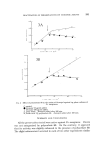
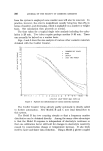
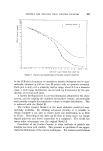
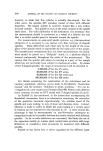
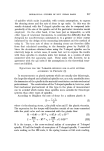
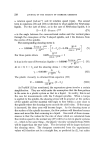
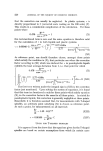
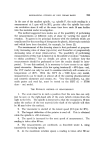
232 JOURNAL OF THE SOCIETY OF COSMETIC CHEMISTS the infinitely high rates of shear would the flow pattern be the same as for Newtonfan liquid systems, and I therefore suggest that you would be very much better suited in using the Haake "Rotovisko" coaxial cylinder viscometer. I am a little worried about the interpretation of Fig. $. I know a lot of stress has been placed upon these during the last 20 or 30 years, but it seems to me that one factor is ignored in a study of this type. One first of all increases the rate of shear and measures the viscosity as one goes up the rate of shear scale which is quite acceptable one then waits a few minutes and starts going down from high to low rate of shear, but at any particular rate of shear there is a time factor involved before the structure can recover, and this is completely ignored in producing histeresis curves. This means that one will get something which is completely untrue if measurements are carried out successively from high to low rate of shear without any interval. I think that it is much more suitable to use a system suggested by Professor Umstedter ca. 1930, i.e. a three-dimensional plot including a time axis. TH• L•CTUR•-R: I have found that the reproducibility with the "Rotovisko" viscometer is not so good as with the Brookfield. We have carried out repeated measurements at one-day intervals because it is impossible to repeat these measure- ments one after another, due to rheodestruction. We have also repeated the measurements after one and two weeks' intervals and have obtained reproducible values. We now have the possibility to predict some properties of creams and to compare these with older preparations. The Helipath stand unfortunately did not give reproducible results, especially for thixotropy, as the spindle at the same point does not allow us to construct rheograms from the values obtained. MR. P. SH•-RMAN: I am not surprised that you carried out experiments with the Haake, and were unable to reproduce these one or two days later. If you get correlation at all with the Brookfield I would be inclined to say the Brookfield was in error and not the Haake. We have carried out very close studies at a very wide range of shears, from very high ones down to fractions of a reciprocal second, and find in every emulsion system (we are particularly interested in con- centrated w/o emulsions approaching the consistency of those that you have used) that their rheological properties are changing from the moment they are made. We have also found, when working at very low rates of shear, that on measuring viscosity one can get a three or four fold decrease in the value of the viscosity within 40 to 24 hr of manufacture. It is therefore not surprising that you can not get reproducible results with a Haake if you test immediately after preparation, and 24 hr later. THE L•-CTUR•R: Our emulsions were stable, and the flocculation which you have mentioned will appear in unstable emulsions and to a lesser extent in stable emulsions. MR. P. SH•-RMAN: In a w/o emulsion you will get flocculation from the moment of preparation. Stability, however, has nothing to do with flocculation it refers to the coagulation or coalescence of the droplets, and the rheological changes are primarily due to this. You will find that in an emulsion system you have a certain proportion of very small droplets which are very unstable, even though the larger droplets are stable these very small droplets contribute enormously to the theological parts of the system. They are very unstable and disappear within one or two days of manufacture. MR. N.J. VAN 'ABB•: For many years I have been bothered by the discreet
Purchased for the exclusive use of nofirst nolast (unknown)
From: SCC Media Library & Resource Center (library.scconline.org)