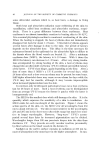
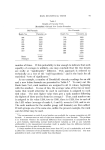
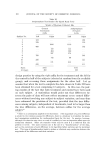
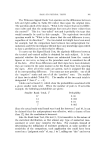
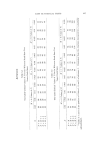
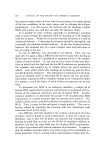
EASY STATISTICAl. TESTS lol The Wileoxon Signed Rank Test operates on the differences between left and right axillae in Table III rather than upon the original data. The question asked of the data is, "What is the chance that no real differ- ence exists and that the antiperspirant does not give lower values than the control?" This is a "one-tailed" test and is probably the type that would normally be used in this example. The equivalent two-tailed question would be "What is the chance that the real difference is zero, regardless of its direction?" The two-tailed test might have been used, for example, had the comparison been between two antiperspirant for- mulations and if the investigator did not have any knowledge upon which to base a prediction as to their relative efficacy. To carry out the Signed Rank Test, the algebraic difference between the treated and control axillae is obtained for each subject. It is im- material whether the treated items are subtracted from the control figures or vice versa, as long as the procedure used is consistent for all of the data. After these differences and their signs have been obtained, they are ranked in the same manner as for the Rank Sum Test, ignoring the signs. After all of the ranks are gotten, each is assigned the sign of its corresponding difference. Two sums are now possible: one of all the "negative" ranks and one of all the "positive" ones. The smaller of these two is added (Table IV). The smaller of the two rank totals is designated T (here T = --9). Tables can be found (1) which show the probabilities associated with a given smaller rank total. When the number of pairs is 12 as in this example, the following probabilities are given: Smaller Rank Total, 7' Probability 17 0.05 14 O. 025 10 0.01 7 O. 005 Since the actual rank total found was 9 and lies between 7 and 10, it can be claimed that the antiperspirant was effective, with a chance of less than 1% that the conclusion is incorrect. Like the Rank Sum Test, this test (1, 2) is insensitive to the nature of the statistical distribution, so that almost any type of numerical mea- surement or score may comprise the data. For example, instead of determining the milligrams of moisture produced, at some sacrifice of sensitivity of the comparison, each application site could have been scored on a "judgment scale" of, say, 1 to 7, calling one "dry" and seven

102 JOURNAL OF THE SOCIETY OF COSMETIC CHEMISTS Table IV Ranking of Antiperspirant Test Data-Signed Rank Test Subject Mg Moisture Control- No. Control Treated Treated Rank 1 251 201 %.50 %. 4 2 258 150 %.108 %. 5.5 3 1006 1116 -- 110 -- 7 4 669 702 --33 -- 2 5 150 131 %.19 %. 1 6 484 350 %.134 %.10 7 397 274 %.123 %. 9 8 783 503 %..289 %.12 9 142 99 %.43 d- 3 10 380 151 %..229 %.11 11 721 613 %..108 %- 5.5 12 522 411 %.ill q- 8 Sums 5763 4701 + 1253 • Averages 480 390 + 104 Sum of (%.) ranks = %.69 Sum of (--)ranks = --9 T=9 Algebraic sum. "very moist." As before, the number of ties encountered should not exceed about 10% of the total number of differences in the group. If a difference of zero is obtained, this set of data (subject) is not ranked, but is eliminated from consideration, and the number of pairs then con- sidered to be one less than the actual number used. MULTIPLE RANK TEST FOR PAIRED DATA This procedure, as well as a related one for unpaired data, is described in reference 1. The application is to a situation where more than two treatments are used and the experimenter wishes to determine: whether he can claim that a real difference exists between the means of any pair of subjects if so, which of the differences are involved and the probability of an incorrect conclusion in each case. As discussed briefly above, both of the preceding tests operate by allowing the determination of the probability that an observed difference between means or a mean difference has occurred purely by chance. If this probability is statistically small, the experimenter may feel that the
Purchased for the exclusive use of nofirst nolast (unknown)
From: SCC Media Library & Resource Center (library.scconline.org)