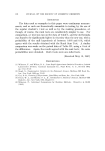
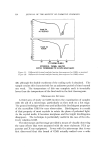
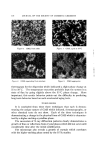
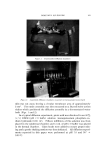
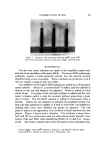
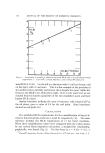
116 JOURNAL OF THE SOCIETY OF COSMETIC CHEMISTS Figure 6. GMS, fresh slide Figure. 7 GMS, aged at 35øC ' ' • .•'•,'•' • ¾•4'•*d..: '- :: •. 2 .•'. Figure 8. GM8 separating from mixture Figure 9. GMS aggregates thermogram for the dispersion which indicated a slight phase change at 35 to 38 øC. The temperature excursion probably kept the system in a state of flux by going slightly above the 35 øC phase change. More important, this erratic behavior points out the difficulty in predicting long-term behavior based on such accelerated aging tests. CONCLUSIONS It is concluded from these three techniques that each is demon- strating the unique nature of GMS which infrared, chromatography, or other chemical tests do not show. Each of the three techniques is demonstrating a change in the physical form of GMS which is character- ized by a higher-melting crystalline phase. The succession of X-ray diffraction patterns dearly demonstrates a growth of lines or reflections from crystal planes which did not exist until considerable time after the initial solidification. The microscope also reveals a growth of crystals which correlates with the higher-melting phase noted by the DTA studies.

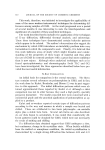
GLYCERYL MONOSTEARATE 117 The implications of this work are also significant because this change in form can occur when GMS is in combination with other constituents. It is also known that similar behavior can be observed of other stearate esters. Because of the wide use of these compounds, the importance of a knowledge of this behavior is obvious. Hoerr has stated in a paper (2) his belief that the various polymorphs and sub forms can be explained on a basis of purity of material. He sug- gests that the keterogeneeus •ature of these compounds retards crystalli- zation, but eventually, given suitable conditions, the crystallization will take place. This description seems to fit the observations reported here, particu- larly in the microscopic examination of mixtures of GMS with other components. Here one can actually see the growth of crystals and ap- parently at the expense of the surrounding material. Under such circumstances, the crystallization theory seems more appropriate than the conversion of a mass of material from one form to another. From this theory one can speculate that certain constituents might be isolated and identified which could retard crystallization better than others. This should be a fruitful area of research. The techniques and instrumentation for the analytical work are available aS never be fore. A combination of these assets and experience in emulsion tech- nology should produce valuable data for a wide variety of users. (Received May 19, 1967) RI•FERENCES (1) Kuhrt, N.H., Broxholm, R. A., and Blum, W. P., Conjoined crystals. I. Composition and physical properties, J. Am. Oil Chemists' Soc., 4,725-733 (1963). (2) Hoerr, C. W., X-ray diffraction of fats, Ibid., News Ed., 41, 4 (1964).
Purchased for the exclusive use of nofirst nolast (unknown)
From: SCC Media Library & Resource Center (library.scconline.org)