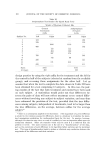
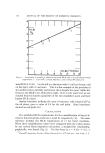
130 JOURNAL OF THE SOCIETY OF COSMETIC CHEM1STS the numbers increase. Such series include the Span ©* and Tween ©* group and the Neutronyx©• surfactants. There are, of course, other tradename series too numerous to list here. Several authors have reported attempts to relate HLB to various other properties of the surfactant molecules (5-8). At present, how- ever, the most direct method, which at the same time includes factors in addition to the HLB itself, is actually to make a set of emulsions, using the desired oil phase, and varying the HLB throughout the set in a regu- lar manner. HLB values intermediate between those of commercial products can be achieved by mere mixing of these products. For ex- ample, blending 70% Tween 80 (HLB of 15) and 30% Span 80 (HLB of 4.3) (0.70 X 15) + (0.30 X 4.3) = 11.8, HLB of the blend. Thus, a higher-HLB emulsifier is mixed with a lower-HLB emulsifier in such pro- portions that the average HLB's of the several mixtures as calculated show a regular variation. The emulsions in the series are then com- pleted, and their stabilities are observed. The most stable ones cluster around a particular HLB range. Then, another set of emulsions is made, to range more compactly around this HLB stability-peak and sub- divide the values more finely than in the first set. This narrowing down process can be carried out further until an almost infinitesimal range is covered but there is a practical limit of refinement left to the judg- ment of the chemist. It is perfectly proper to speak of the HLB of a nonsurfactant, such as mineral oil. In this sense, we refer to the HLB required by the mineral oil to become emulsified, even though the oil itself has no duality of both oil- and water-solubility. In fact, mineral oil requires an HLB of 10 to become emulsified in water, and an HLB of 1.8 to form a water-in-oil system. The author has found that, for preliminary screening, a rapid titra- tion procedure is highly useful. Briefly, a water solution of the higher- HLB material is titrated with a solution of the lower-HLB material, in the presence of the oil phase. An indicator is used, the most dependable found so far being a carbon black. At the end point, the carbon mi- grates from the water phase into the oil, with high visibility. Under the experimental conditions detailed below, emulsification of the oil does not occur at the end point, and the phase separation is rapid. The crucial effect seems to be on the carbon black itself rather than on the oil phase, although this is still somewhat conjectural. * Atlas Chemical Industries, Inc., Wilmington, Del. t Onyx Chemical Co., Jersey City, N.J.

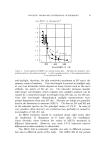
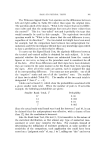
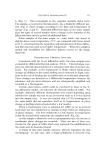
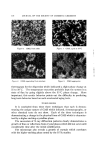
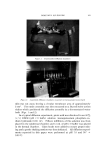
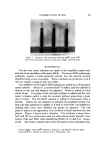
DETERMINATION OF HLB 131 Figure 1. Titration with Neutronyx 640 and 626 ©, Lorol //5. © Left, before end point Center, at end point Right, after end point EXPERIMENTAL Ten per cent water solutions are made of the emulsifier under test, and also of an emulsifier with known HLB. The lower HLB surfactants ordinarily require a hydro-alcoholic solvent, but the alcohol content should be kept as low as possible. Water solutions are preferred, even if they are cloudy, as long as they are stable. Ten milliliters of the higher-HLB solution are added to a 100-ml grad- uated cylinder. About 0.1 g carbon black* is added, and the cylinder is shaken to wet out and disperse the pigment. Water is added to total about 80 ml. Ten grams of the selected oil phase is added and the con- tainer is shaken gently to mix the contents without generating a great deal of foam. The low-HLB solution is added in increments from a burette. Unless one can estimate in advance the probable titrant vol- ume and thus approach it rapidly, it is well to start with 1-ml additions, shaking after each, then allowing the phases to separate. The end point is taken as an apparently even division of black between the two phases. Figure 1 shows such a titration. The oil phase is lauryl alco- holt and the two surfactants used are ethoxylated nonyl phenols, Neu- tronyx //640 and //626, with emulsifying HLB's of 15 and 10.7, respec- tively. The center cylinder shows the end point at the calculated mix- * Carbon Black, Vulcan #9 ©, Godfrey L. Cabot Co., 125 High St., Boston, Mass. ,+ Lorol #5, © E. I. dupont de Nemours & Co., Wilmington, Del.
Purchased for the exclusive use of nofirst nolast (unknown)
From: SCC Media Library & Resource Center (library.scconline.org)