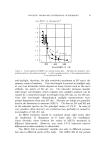
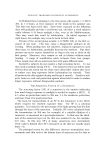
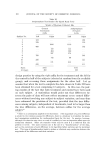
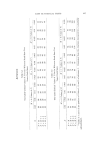
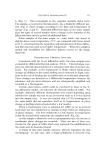
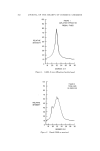
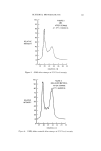
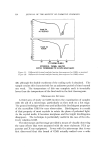
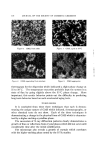
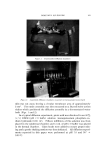
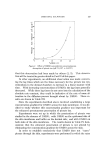
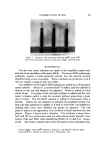
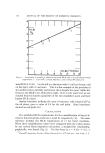
132 JOURNAL OF THE SOCIETY OF COSMETIC CHEMISTS 16 14 12 I I I I IHLB I (Tran, 'sfer) 2 4 6 8 10 12 14 16, Figure 2. Correlation of transfer or titration end point HLB with o/w emulsification HLB requirement: 1. Lorol #b ©, 2. Butyl Myristate, and 3. Klearol© mineral oil ture HLB of 12.66. On the left is a titration with 0.5 ml less titrant, and on the right, with 0.5 ml more. This is a fine example of the precision of the method when carefully performed, since despite the great visible dif- ferences, the HLB's are, from left to right, 12.70, 12.66, and 12.62, as cal- culated from the known quantities of the two emulsifiers used, and their known HLB values. Similar titrations utilizing the same Neutronyx, with mineral oil* as the oil phase, gave a value of 3.6 for the end point. Butyl myristate showed an end point at 6. CALCULATIONS The published HLB requirements for the emulsification of lauryl al- cohol or mineral oil into water are 14 and 10, respectively (9). The same reference includes the HLB requirement of 11 for butyl myristate. When these emulsification values were compared with the values shown by our carbon black migration end points, a straight-line relationship, graphically, was found (Fig. 2). The line-locus is y = 0.45x -[- 8.3 y * Klearol©, Sonneborn Division (Witco Chemical Co.), 277 Park Ave., New York, N.Y.

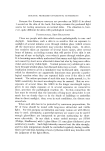
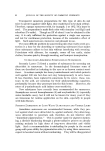
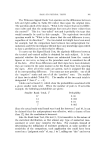
DETERMINATION OF HLB 133 being the O/W emulsification HLB requirement, and x the HLB found by the carbon black titration. To date, all relatively pure chemicals which have been standardized and which have O/W HLB values published agree with this relationship. It might appear from the graph of Fig. 2 that oil phases having an HLB requirement below 8 cannot be characterized by this titration method. In a few cases, the author has performed titrations which gave negative values after calculating the end point HLB. When these nega- tive values were substituted into the line equation, however, O/W HLB values resulted which were below 8, and quite verifiable by preparing a stable emulsion therewith. APPLICATIONS Although this method has been applied successfully in several tech- nical service problems having to do with emulsifying, no attempt to de- velop a library of HLB values for commercial emulsifiers, or for oils, has been made. Many emulsifier values have been published by sup- pliers or are available from the suppliers concerned. As is true in all experimental or analytical work, precautions must be taken, limitations of a method must be recognized, and good judgment must be used. Also, unfortunately, there will probably always be in- stances when a method just won't work because of undetermined inter- ferences. The carbon black selected is fine enough to disperse into an intensely black suspension, but it is very important that it actually be well dis- persed initially. With certain types of nonionics which may not wet- out well, even though the HLB is high, it is best to start a fresh cylinder with 1 ml of a 10% solution of another nonionic of known HLB that is a good dispersant, add and wet-out the carbon black, and make up to the 10 ml specified with the high-HLB solution under test. Once the carbon is dispersed, it will ordinarily remain so. The dispersant added must be included in the final calculation of the end point HLB. It is necessary to shake the cylinder just before each addition of ti- trant. If titrant is added to the oil phase directly, floating at the top as it does, the local concentration of low-HLB titrant thus added into the oil will usually distort the end point. A sufficiently low HLB will oil- wet the carbon whether this HLB is reached in the normal course of the titration or accidentally. The carbon presumably cannot distinguish the intention of the chemist. Once wet by the oil, the carbon does not readily divest itself to become once more water-wet. This appears to be
Purchased for the exclusive use of nofirst nolast (unknown)
From: SCC Media Library & Resource Center (library.scconline.org)