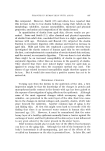
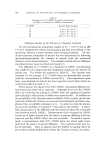
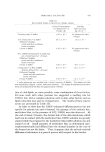
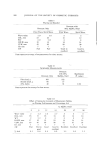
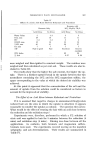
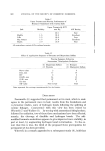
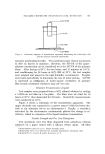
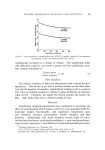
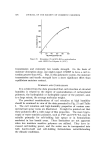
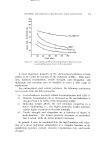
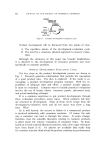
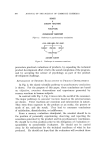
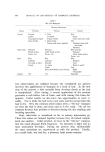
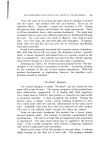
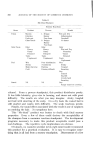
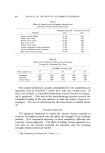
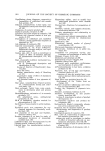
844 JOURNAL OF THE SOCIETY OF COSMETIC CHEMISTS Table II Penetration of C•4-DMSO Through Excised Guinea Pig Skin as a Function of DMSO Concentration % DMSO Absolute Rate Constant 20 3.12 X 10 -4 cm hr -• 40 6.46 X 10 -4 cm hr -• 60 11.9 X 10 -4 cm hr -• 80 357.0 X 10 -4 cm hr -• Diffusion Studies in the Presence of Dimethyl Sulfoxide In vitro percutaneous absorption studies at 30 + 0.05 øC and at pH 7.0 were conducted in which excised guinea pig skin was utilized as the membrane between a donor chamber and a receptor chamber. The rate of percutaneous absorption of picrate ion was determined by following spectrophotometrically the transfer of picrate from the epidermal chamber to the dermal chamber. The complete details of these diffusion experiments have been described previously (1). The diffusion of C14-DMS0 as a function of DMS0 concentration was studied in the guinea pig skin membrane system in the absence of picrate ion. The results are reported in Table II. The absolute rate constant for the passage of C•4-DMSO does not dramatically increase until the concentration of DMS0 exceeds 60%. This dependence upon large concentrations of solvent has been reported several times before in connection with this work (1, 2). }Vhen picrate was dissolved in 80% DMS0, substantial diffusion en- hancement was observed as expected. Attempts to reverse the DMSO effect by removing the picrate in DMS0 from the epidermal chamber and replacing it with picrate in buffer were unsuccessful. In addition to the possibility of the inherent nonreversibility of the system, picrate ion reservoirs within the Stratum corneum and bacteriological problems com- plicated the reversibility attempts (4, 5). In order to avoid the picrate ion reservoir problem, n-butanol-C TM was used as the burden. A three- fold enhancement of the diffusion rate was observed when the n-butanol was dissolved in 80% DMS0. Replacement of the n-butanol in DMSO by picrate in buffer showed that the barrier to picrate diffusion had been removed and the DMS0 effect was not reversible. In another experi- ment, a pretreatment with 80% DMS0 alone for about eight hours destroyed the barrier to picrate diffusion. The controls in this case be- haved normally. Thus, it appears that the DMS0 is causing either an irreversible protein modification within the Stratum corneum, an extrac-

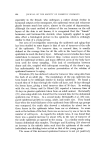
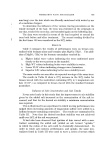
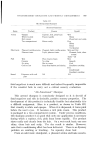
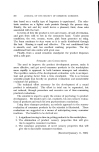
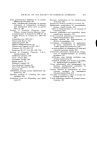
DIMETHYL SULFOXIDE S45 Table III Reversibility Study on Skin From a Single Animal Control-picrate in buffer Test n-butanol-C •4 in buffer Diffusion Chaxnber rinsed and skin membrane frozen overnight Pictate in buffer $0% DMSO pretreatment of epidermal side of membrane for •-•8 hours Diffusion Chamber rinsed and skin membrane frozen overnight Picrate in buffer n-Butanol-C n in 80% DMSO (kinetics followed for •8 hours) Diffusion Chamber rinsed and skin membrane frozen overnight Picrate in buffer Initial Concentration of n-Butanol-C TM or Picrate (M) Absolute Rate Constant kp (cm hr -1) 4.95 X 10⁻² 36.7 X 10⁻² 4.95 X 10⁻² No penetration after 8 hours 24.[½ X 10 t No penetration after 8 hours 4.95 X 10 -• 43.4 X 10 -• 46.0 X 10 -2 8'2.'2 X 10 -i 4.95 X 10 -2 57.2 X 10 -• A male guinea pig was sacrifled with a lethal injection of MgSO4. The abdominal skin was immediately clipped, excised, and frozen until use. The length of time between procure- ment and utilization of the skin was approximately 19 hours. tion of vital lipids, or, more possibly, some combination of these factors. Previous work with other proteins has suggested a swelling role for DMSO, but, with a complex substrate such as skin, other factors such as lipid extraction may also be of importance. The results of these experi- ments are presented in Table III. In order to show that the DMSO-enhanced diffusion process was not specific for picrate ion and n-butanol, the passage of the cationic dye, methylene blue, in the presence of 80% DMSO was also observed. At the end of about 24 hours, the dermal side of the skin membrane which had been in contact with the methylene blue-DMSO solution was grossly stained while that exposed to the methylene blue-buffer solution was not stained at all. Small amounts of methylene blue as determined spec- trophotometrically had diffused into the dermal chamber in the case of the fornter but not the latter. Thus, it appears that the solvent-assisted diffusion of substances is a general process with respect to the burden.
Purchased for the exclusive use of nofirst nolast (unknown)
From: SCC Media Library & Resource Center (library.scconline.org)