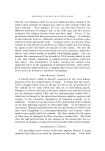
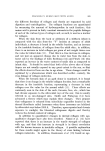
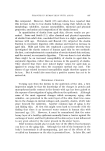
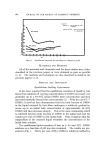
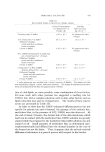
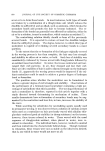
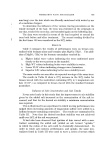
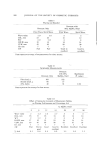
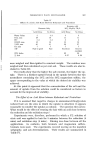
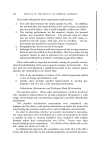
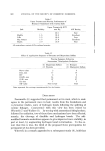
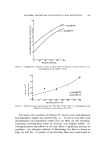
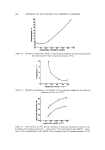
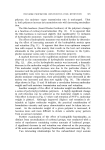
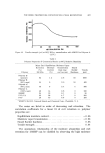
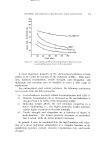
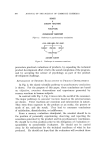
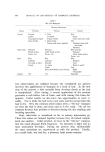
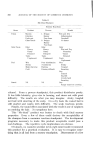
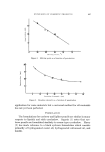
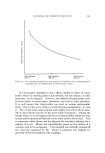
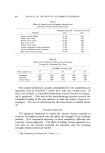
POLYMER PROPERTIES INFLUENCING CURL RETENTION 877 Figure 19. 80O 600 400 200 0 2b 46 6b 8b •oo NEUTRALIZATION (%) Tensile strength (psi) at 90% RH rs. neutralization with AMPD for Polymer A (2•øC) Table I Polymer Properties of Commercial Resins at 9070 Relative Humidity Polymer Mean Curl Equilibrium Moisture Vapor Retention Moisture Transmission Sward (%) Content Rate (my/ Rocker Tensile 180 Min (%) cm2/sec/cm) Hardness (psi) Polymer B (unneut) 63 1.5 2.6 16 1000 Polymer B (60% neut) 54 6 3.0 10 400 Polymer A • (60% neut) 49 9 3.4 4 360 Polymer A (100% neut) 46 14 3.8 0 230 DMHF 34 13 6.1 0 30 PVP/VA 33 38 4.7 0 200 PVP 28 45 6.9 0 200 • RESYN 28-1310, National Starch and Chemical Corp., Plainfield, N.J. The resins are listed in order of decreasing curl retention. The correlation coefficients for a linear fit of curl retention vs. polymer properties are' Equilibrium moisture content .......................... --0.86 Moisture vapor transmission ........................... --0.93 Sward Rocker hardness ............. '•. :-. ............... 0.88 Tensile strength ...................................... 0.84 The anomalous relationship of the moisture absorption and curl retention for DMHF can be clarified by observing the high moisture

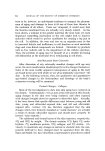
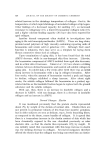
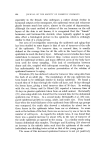
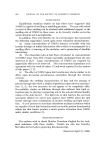
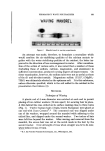
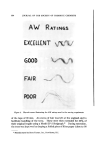
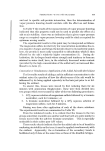
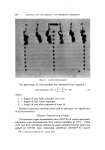
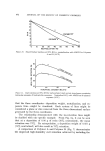
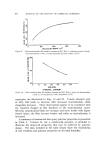
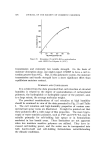
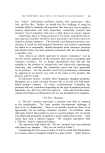
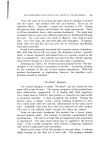
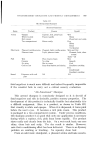
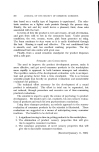
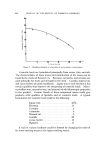
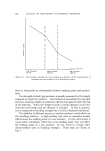
878 JOURNAL OF THE SOCIETY OF COSMETIC CHEMISTS 200 160' • ,•o. z ,• 80' z o,/ "' 40' 0 2•) 40 60 80 I00 NEUTRALIZATION (%) Figure 20. Elongation (%) at 90 % RH rs. neutralization with AMPD for Polymer A (22øC) transmission and extremely low tensile strength. On the basis of moisture absorption alone, one might expect DMHF to have a curl re- tention greater than 46%. But, in this polymeric system, the moisture transmission and tensile strength have a more significant effect than equilibrium moisture content. SUMMARY AND CONCLUSIONS It is evident from the data presented that curl retention at elevated humidity is related to the degree of neuturalization of carboxylated polymers, the hydrophobic or hydrophilic nature of the polymer, and, to a large extent, the average molecular weight. The practical considerations of curl retention at high humidity should be examined in view of the data presented in Fig. 21 and Table I. The curl retention and high-humidity properties of various com- mercial hair spray resins are illustrated. It might be pointed out that these polymers offer a wide range of film properties. The more hygro- scopic or water-sensitive polymers, such as PVP and PVP/VA, may be suitable primarily for soft-holding hair sprays or in formulations marketed in less humid areas. These limitations are not apparent when less moisture sensitive polymers are utilized. They have in- creased curl-holding power, and the resins can be incorporated into both hard-to-hold and soft-holding formulations notwithstanding the climatic conditions.
Purchased for the exclusive use of nofirst nolast (unknown)
From: SCC Media Library & Resource Center (library.scconline.org)