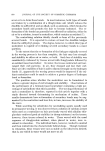
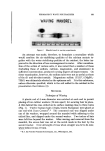
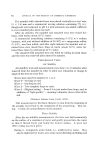
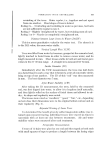
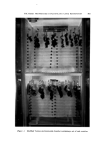
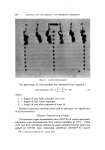
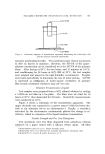
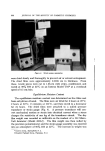
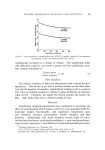
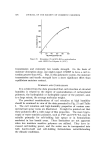
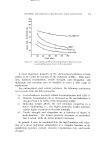
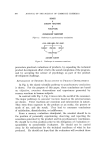
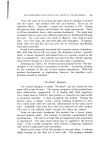
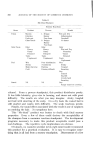
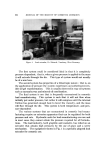
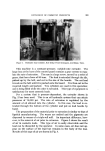
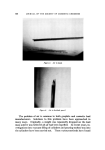
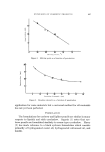
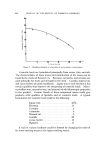
EXTRUSION OF COSMETIC PRODUCTS 895 '•.. • . i .:: • .. ::- ..... •X': .... .i•:::':. • {• •..' '•.., ß •' . .5::.:..:::a,..:.•. %%.., ß :y. .y.•- • ..:'• '•v:'. . -• . ,:.., . .::- -.:---. ...... ß . ß .... '. .'•:,..,4 ....•,:•:•.:...... Figure 2. Hydraulic lead extruder, Red Cedar Pencil Company, Lewisburg, Tenn. This machine is a constant-pressure, variable-rate extruder. The large box at the base of the control panel contains a gear system to regu- late the rate of extrusion. The ram is a large screw, turned by a series of gears, that has a force of 90 tons. The lead is extruded through the die, picked up by the belt, and cut to the size of the boards. The cut lead travels on the belt until it is pushed onto the board. It is then cut to the required length and packed. Two cylinders are used in this operation one is being filled while the other is extruded. This type of equipment is satisfactory for most cosmetic leads. For a system that is pressure-dependent, the extruder shown in Fig. 2 has been used. This is an oil hydraulic system that can attain pressures of 75,000 psi. The rate of extrusion is regulated by the amount of oil allowed into the cylinder. In this case, the lead is ex- truded through the bottom of the cylinder and put on lead boards by hand. The preparation of the material prior to extrusion is similar to that of lipstick manufacturing. The waxes are melted and the pigments are dispersed by means of a triple-roll mill. An important difference, how- ever, is the removal of air prior to extrusion. Figure 3 shows the result of air in cosmetic leads. This type of air is easily observable and the lead can be discarded by the operator. In some cases, air does not ap- pear on the surface of the lead but remains in the body of the wax. Results of this type of air are shown in Fig. 4.

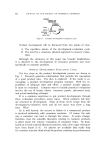
896 JOURNAL OF THE SOCIETY OF COSMETIC CHEMISTS Figure 3. ß ' • ,'.,'•:':...:.'.•'.":. •.. i' Air in leads Figure 4. Air in finished pencil The problem of air is common to both graphite and cosmetic lead manufacturers. Solutions to this problem have been approached in many ways. Originally, a weight was repeatedly dropped on the lead mass until it was believed all air had been expelled. In recent years, in- vestigations into vacuum filling of cylinders and pouring molten wax into the cylinders have been carried out. These various methods have found
Purchased for the exclusive use of nofirst nolast (unknown)
From: SCC Media Library & Resource Center (library.scconline.org)