J. Soc. Cosmetic Chemists 20 451-466 (1969) ¸ 1969 Society of Cosmetic Chemists of Great Britain An adhesive-tape stripping technique for epidermal histology H. L. JENKINS and J. A. TRESISE* Presented at the Symposium on "Skin", organised by the Society of Cosmetic Chemists of Great Britain, at Eastbourne, Sussex, on 19th November 1968. Synopsis--A quick, easy, and reliable tape stripping method for investigating the structure of the skin's surface layers has been developed and tested by frequent use over several years. It involves application of Sellotape to skin with a roller, and transference of cells to albumin- coated slides. This technique has led to the recognition of three distinct stages in the matura- tion of corneum cells. The same cell types were found in the same pattern of distribution in mouse, rat, hamster, guinea-pig, rabbit, and man. There were differences in the ease with which the corneum of different species could be stripped. There appeared to be differences in corneum cell diameter between species. The diameter of corncure cells of 4-day old rats was smaller than that of 2- to 3-week old rats. In hunran corneum regional variation was recognisable. Four groups of regions could be distinguished by the patterning and grouping of their surface cells: trunk and limbs, dorsum of hand and foot, palm and sole, cheek and forehead. Some of these regions also differed in corneum cell diameter. INTRODUCTION Adhesive-tape has been widely used in recent years for removal of cells from the skin surface. But in most cases the cells removed have not been studied. Pinkus (1) surveyed this subject and concluded that most exponents of tape-stripping were interested either in using the stripped site for penetration studies, or in using it to study regeneration. Few people were interested in the morphology of the stripped-off tissue. , *Unilever Research Laboratory, Sharnbrook, Bedford. 451

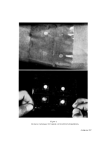
452 JOURNAL OF THE SOCIETY OF COSMETIC CHEMISTS Wolf (2) is generally regarded as the originator of tape stripping as a dermatological technique. He used it (2) to obtain thin sheets of superficial corneum cells in which he demonstrated various types of intracellular granules using a modified gram stain, and later (3) described the fine struc- ture of the cells' surfaces. He developed two refinements of the method which have received surprisingly little attention by others. The removal of coherent sheets of cells was enhanced by first coating the skin with celloidin. The study of internal structure was facilitated by transferring cells from tape to microscope slide, and then staining them. Transference was achieved by applying the cell-bearing tape to a slide which had two to three drops of xylol-ether mixture on its surface. The xylol-ether dissolved the tape's adhesive so that after 5-10 min the tape could be peeled off, leaving the cells on the slide. Keddie, Orr and Liebes (4) developed a differ- ent method of transference. They coated slides with gelatin, fixed and dried the film, then put tape with cells on to the slide and immersed it in carbon tetrachloride for 24 h. After that the tape backing could be peeled off the slide. Goldschmidt and Kligman (5) put cells on slides by a quite different approach. They coated slides with adhesive, and used the sticky slides to remove cells from the skin surface. The method which we will describe has some resemblances to those of Wolf and Keddie. We coat our slides with albumin, as in normal histo- logical practice. The tape with its corneum cells is put firmly on to the slide, and the cells given time to become stuck to the slide by incubation at 60øC. It is immersed in toluene overnight, after which the tape falls off or can be easily peeled off. The cells can then be stained by normal histological methods. Goldschmidt and Kligman (5) consider that a transference method is likely to result in too much loss or damage of cells. We have now made many permanent preparations in this way, and have never noticed appreciable loss of tissue. Damage to tissue is usually not apparently significant. Since our procedure, at all stages, in.volves standard histological operations--staining, dehydrating, clearing--it is not expected to be abnormally damaging. This report gives the details of our technique, and a brief account of some relevant factors which have been investigated. It describes the characteristic appearance of epidermal cells in tape-strippings, and illus- trates how recognisably different cells appear to be distributed in the stratum corneum. Finally, there is an account of the use of the method to compare the corneum of various species of mammals, and to compare the corneum of various regions of the human body.
Purchased for the exclusive use of nofirst nolast (unknown)
From: SCC Media Library & Resource Center (library.scconline.org)