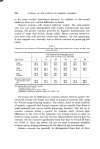
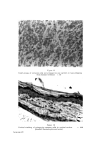
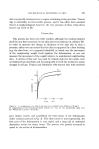
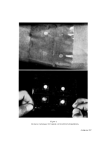
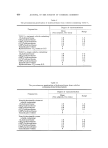
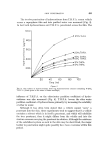
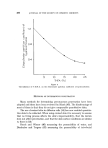
SKIN PENETRATION 499 DISCUSSION MR. M. J. BUSSE: I think if you plot the results in Tables I and JI on the effect of hydrocortisone in vehicles containing T.H.F.A. and dimethylacetamide on the vaso- constriction response you will show a very approximate linear relationship between log concentration of hydrocortisone and the vasoconstrictor response, and I suspect that if you had slightly extended the concentrations in the upper and lower range of hydrocortisone, you would have obtained a Sigmoid-shaped curve. In _Fig. oe the responses are shown to 0.5% and 0.1% betamethasone-17-valerate in a cream base. In my laboratory work I have shown that if you plot log concentration of tetra- methasone valerate in a cream base against the vasoconstrictor response, one gets the classical biological response Sigmoid-shaped curve and the linear portion of this Sigmoid-shaped curve lies between concentrations of 0.0001% and 0.001% of beta- methasone-17-valerate, and the 0.5% and 0.01% concentrations shown in _Fig. oe would appear to be supramaximal for vasoconstriction. When I calculated the doses of betamethasone-17-valerate in cream base required to cause vasoconstriction in 50% of subjects, the actual dosage in gg correlate very closely with those found origin- ally in the work of McKenzie and Atkinson (49). THE LECTURER: We have tried unsuccessfully to produce a vasoconstriction using concentrations of betamethasone-17-valerate lower than 0.05%. I think it is important to remember the technique that we were using, i.e. applying approx. 7.Smg of medicaments (viz. vehicle with betamethasone valerate, not betamethasone- 17-valerate) to a small area of skin and, therefore, one cannot necessarily compare results unless one has a similar experimental scheme. This is quite a small amount of vehicle to apply to the skin, but we thought that the thickness applied was fairly close to that which would be apphed in a normal condition, and we did not produce vasoconstriction at concentrations lower than 0.05%, possibly because of our technique. MR. M. J. 13USSE: Using your technique have you tried concentrations of betametha- sone-17-valerate lower than 0.05% in a cream base? It would have been very interesting to have seen an attempt to produce vaso- constriction with hydrocortisone in a vehicle without the penerrant solvents in an attempt to produce a similar dose response curve as is shown in Tables I and II, and thereby attempting to calculate a potency ratio for hydrocortisone in a vehicle with, and without, solvents. THE LECTURER: We tried 1% hydrocortisone in the pharmocopaeal cream and ointment bases, and got no response at all we were therefore unable to tackle this problem. A MEMBER OF TH• AUDieNCE: In page 488 you state that some substances will pass through the skin without eliciting an untoward reaction whilst others will produce skin reactions by penetrating only the upper layers of the stratum corneum. Would you like to expand a little on this statement could you say what types of materials you have in mind? THE LECTURER: I was concerned here with the various groups of irritant response i.e. those materials that only damage cells in the stratum corneum, not necessarily producing damage any further down in the skin, e.g. dilute acids and alkalis. {49) McKenzie, A.W. and Atkinson, R. M. Arch. Dermatol., 89 741 (1964).

Book reviews MEDICAL AND VETERINARY CHEMICALS. R. Slack and A. W. Nineham. VOL. 1. Parts I and II. Pp. xvi + 254 + Ill. VOL. •o. Part III. Pp. v. + 208. (1968). Pergamon Press, Oxford. :•6. The volumes under review are from a series under the rather imposing general heading of 'The Commonwealth and International Library of Science, Technology, Engineering and Liberal Studies'. Even if this is not just a sales gimmick by Pergamon intended to give an impression of 'official' blessing where in fact none exists or is justified, surely something a little less pretentious would suffice? It is stated in the foreword that it is the authors' intention to present an impartial account of the pharmaceutical industry, with particular reference to drug research, so that the reader may judge for himself whether the adoption of some of the recommendations in the Sainsbury Report (reduction of patent protection, no brand names, establish- ment of Medicines Commission) would provide the 'greatest good for the greatest number of people'. With this end in view, the authors have empha- sised, but not exaggerated, the tortuous nature of the road to a new drug - expenditure and work, frustration and heartbreak. Even hard won success may be short lived because of the marketing by another company of a more potent competitive drug having fewer side effects. Volume 1 consists of an introduction giving a brief account of the part played by chemistry in the history of medicine, a chapter describing the nature and structure of the pharmaceutical industry and giving prominence to research expenditure, a chapter outlining the processes by which a new drug is discussed and what is involved in developing the discovery into a market- able product, and ten chapters examin- ing some of the sucesses and a few of the more outstanding failures of drug research together with structural formulae, syntheses and discussions on biological and clinical aspects. Volume 2 presents a classified Table of the more important prototype drugs with struc- tural formulae, references to dates and places of discovery and the names of key workers associated with the compound. The authors display an astonishingly wide knowledge of the pharmaceutical industry, its products and the different sciences and technologies involved in drug research. However, without a good deal of literature searching, the reader cannot readily check up on the many facts quoted since, although there is a formidable bibliography hardly any references are given. Certainly one's suspicions as to the general veracity of the text may be aroused by the informa- tion that the sedative Welldorm was introduced after the thalidomide disaster (wrong: Welldorm was described in the 1958 edition of Martindale's Extra Pharmacopoeia, three years before the thalidomide tragedy) and that the amphetamines have been classed as Dangerous Drugs since 1966 (wrong: 501
Purchased for the exclusive use of nofirst nolast (unknown)
From: SCC Media Library & Resource Center (library.scconline.org)