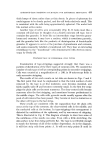
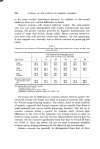
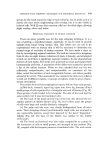
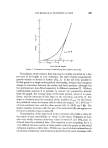
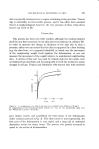
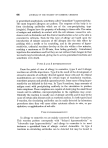
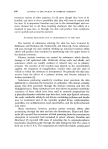
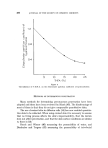
THE MECHANICAL PROPERTIES OF SKIN 469 4 I / / = tan 8 ß / 2 4 I e e Slack = I I Strain (% rest length) Figure I Extension of a strip of excised pig skin [redrawn from (6)]. The primary observation is that skin may be readily stretched by a few per cent of its length at zero extension, but then requires progressively greater tension to stretch it further (Fig. 1). It has not been possible to fit this graph to a single mathematical relationship, owing to the very great change in curvature between the earlier and later portions, although the two portions have been fitted separately to different equations (7). Without mathematical analysis it is possible to extract two parameters directly from the graph, the average slope of the final portion, where it is quasi- linear, and the intercept of this slope on the extension axis (Fig. 1). The slope so obtained gives the maximal elastic modulus (Yn•ax) for the tissue the published values for human skin lie within the range 2 - 11 x 103N cm-2 of cross-sectional area, and for other species 0.8-3 x 10³N cm-2 (6). The elastic modulus increases with the age of the individual (8) and appears to be lower in females than in males (9). Extrapolation of this slope back to the extension axis yields a value for the region of easy extensibility or "slack" in the tissue. Estimates of slack also vary widely between observers values between 3 and 14% may be derived from the published data. This variation is not surprising, for it is very difficult to know exactly at what point to start the graph, as the initial extension requires so little force. Within any one set of observations there is much more consistency and it has been shown that the slack decreases with

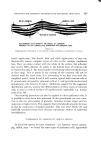
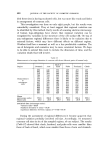
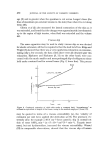
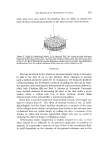
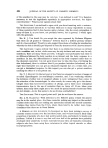
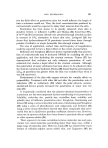
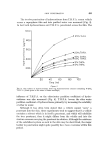
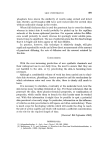
470 JOURNAL OF THE SOCIETY OF COSMETIC CHEMISTS age (2) and is greater when the specimen is cut across Langer's lines (the lines of maximum pre-existent tension in the skin) than when it is cut along them (10). Gibson et al {2) also measured the lateral contraction of the skin as it was extended, and found that the changes were approximately isovolumetric up to the region of high tension, when fluid was extruded and the volume fell. Viscous slip The same apparatus may be used to study viscous slip as was devised for elastic extension all that is required is that the load be left on. Ridge and Wright (7) showed that there was a very rapid stress relaxation on extension, lasting only a few seconds the data cited above were all obtained after this relaxation. Harkness and Harkness {3, 11) on the other hand, were con- cerned with the much smaller and more prolonged slip of collagenous tissue held under constant load for several hours (Fig. 2, lower line). This process Break ,ø"• Normal •Og load • 6o I I 0 50 100 Time, rain trigur• oe Continued extension of chick skin under a constant load "circumference" as ordinate is equivalent to length of the tissue, owing to the method employed [from {12)]. may be quoted in terms of a viscous extensibility (u), the velocity of extension per unit force applied (for derivation see 6). The process is ex- tremely slow for example a 10 N cm-2 force caused a slip in normal rat skin of some 0.05% min-• (u---5 x 10⁻⁵ cm2 N-• min-1). Trypsin treat- ment, but not hyaluronidase, increased the viscous extensibility. Wenze! (13) in comparable observations, showed that the viscous slip of human
Purchased for the exclusive use of nofirst nolast (unknown)
From: SCC Media Library & Resource Center (library.scconline.org)