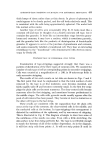
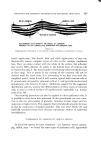
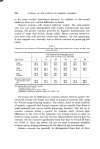
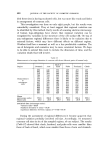
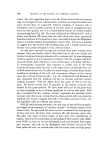
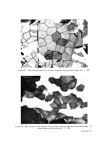
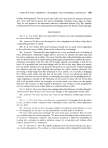
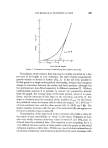
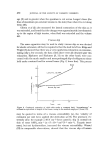
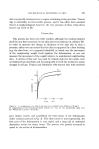
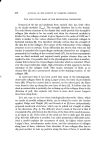
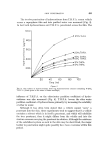
SKIN PENETRATION 495 The in vitro penetration of hydrocortisone from T.H.F.A. cream vehicle across a cuprophane film and into purified water was measured (Fig. 3). In fact both hydrocortisone and T.H.F.A. penetrated across the film. The looo 2 5% IH.EA E 8OO ,-' 600- o .o2_ 20% T, HF.A. o 15% T.H.EA. o 400- 10% T,H.EA, -u 5% T.H.F.A. 'T- 0% T. H.F..A. 200- 20 4'0 40 'oo Tim• (hr') Figure $ The in vitro release of hydrocortisone from 1% hydrocortisone creams containing 0-25 % T.H.F.A. (Each point is the mean of three readings.) influence of T.H.F.A. on the ether/water partition coefficient of hydro- cortisone was also measured (Fig. •t). T.H.F.A. lowers the ether water partition coefficient of hydrocortisone primarily by increasing the solubility of ether in water. Although it has often been stated that a vehicle cannot 'carry' a penerrant into the skin, these experiments tend to suggest that if a vehicle contains a solvent which is in itself a penetrant, and which will solubilise the true penetrant, then it might diffuse from the vehicle and into the stratum corneum carrying the penetrant in solution. Although the existence of the solubilised system as such in the skin may be short lived, the major barrier to penetration might quite possibly have been overcome within this period.

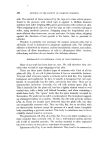
496 JOURNAL OF THE SOCIETY OF COSMETIC CHEMISTS c 1.2 o • • c o c • .o,• 0.8 .4.-,, b •o • o i::::).. u • o4 ! i i ! 5 10 15 20 25 "[H.F.A. (':'/o) Figure 4 The influence of T.H.F.A. on the ether/water partition coefficient of hydrocortisone. METHODS OF DETERMINING PENETRATION Many methods for determining percutaneous penetration have been adopted and these have been reviewed by Blank (45). The disadvantage of most of them is that they do not give comparable quantitative data. The use of excised skin in diffusion cells (14) has now enabled quantita- tive data to be collected. When using excised skin it is necessary to assume that no living process affects the skin's impermeability, that the dermis does not affect penetration, and that the skin surface conditions are similar to those in life. Burch and Winsor (4t3) measuring the permeability of water, and Dirnhuber and Tregear (47) measuriug the permeability of tri-n-butyl
Purchased for the exclusive use of nofirst nolast (unknown)
From: SCC Media Library & Resource Center (library.scconline.org)