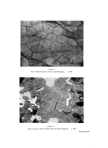
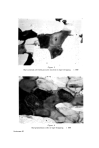
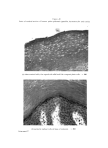
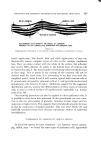
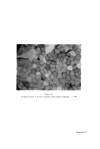
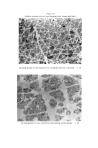
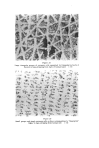
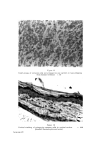
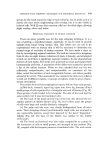
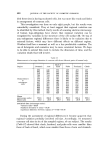
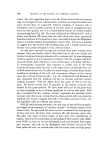
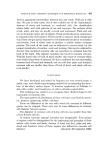
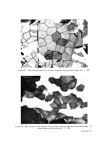
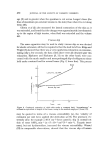
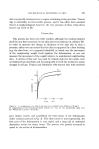
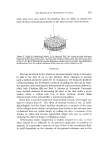
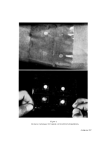
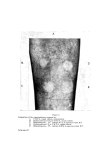
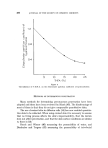
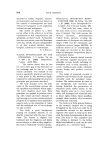
ADHESIVE-TAPE STRIPPING TECHNIQUE FOR EPIDERMAL HISTOLOGY lOP OF CORNEUM TAPE OF COR NEUM THE NUMBERS lto10 IDENTIFY THE PIECES OF CORNEUM REMOVED BY TEN CONSECUTIVE STRIPPINGS WITH ADHESIVE TAPE Figure ,9 Diagrammatic illustration of unevenness of tape-stripping of mammalian corneum fourth application. The fourth, fifth and sixth applications of tape can theoretically remove complete layers of cells, in the example considered here. They can make contact with the •vhole of the surface, but adhesion may not be 100% efficient. At points C, the bottom layer of corneum will be removed in strip 7. The total number of cells being removed •vill decrease at that stage. But at points D the bottom of the corneum will not be reached until the tenth strip. It is interesting to see that even with this simplified model, strips 8 and 9 will contain typical mid-corneum cells at D, granulosum and possibly spinosum cells at C, and pycnotic nuclear (and granulosum) cells between D and C. Additional support for the suggested distribution pattern, and for the differentiation of these types of corneum cells, is seen in vertical sections of hyperkeratotic epidermis, e.g. human palm (Fig. 10). Our counting procedure can also be applied to other epidermal cells. It is possible to strip down into spinosum. In the granulosum one sees varia- tion in th.e size and number of granules. Granules become larger and less numerous at higher levels. This suggests that keratohyalin granules increase in size by coalescence of smaller granules. This •vas what Brody (7) and Snell (8) concluded from their electron microscope studies of epidermal keratinization. COMPARISON OF CORNEUM OF VARIOUS SPECIES In all of the species we have examined - rat, hamster, mouse, guinea- pig, rabbit, man - we found the same types of epidermal cells, apparently

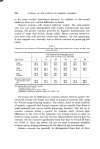
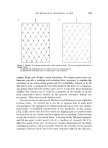
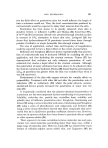
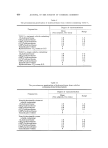
458 JOURNAL OF THE SOCIETY OF COSMETIC CHEMISTS in the same vertical distribution patterns. In addition to this overall similarity there were certain differences in detail. Hamster corneum cells stained relatively weakly. The clear-centred cells were not easily distinguished with routine haematoxylin and eosin staining. The greater contrast provided by Regaud's haematoxylin was needed to make that feature clearly visible. Mouse corneum seemed to have more cells with pycnotic nuclei than hamster, rat and guinea-pig. It also stripped very unevenly, and so did the corneum of guinea-pig and rabbit. Table I Variation of rat corneum cell diameter with age. Each male-female pair, at any one age, was from one litter. Cell diameter in microscope units: each value is mean of 10 readings Age (days) 4 14 25 35 49 56 Male 88.0 93.0 97.9 87.4 93.7 82.6 Female 81.8 92.6 95.6 88.2 88.1 79.3 Male 87.8 94.1 93.1 99.8 95.5 90.2 Female 87.4 98.2 91.6 90.4 87.6 93.9 Male 89.6 92.9 93.3 93.5 Female 89.3 96.5 93.1 96.3 -- Mean per age group: microscope units 87.3 94.7 94.1 92.6 91.2 86.5 •m 38.3 41.6 41.3 40.6 40.0 38.0 Statistical data (microscope units): Variance ratio = 4.12 Standard deviation of mean=87.3 Significant difference between ages (P•- 0.05) •- 4.5 There may also be differences in corneum cell size, between species. We measured average cell length and width in groups of corneum cells, using the Watson image-shearing eyepiece. The results, based on small numbers of animals, suggested that human corneum cells are smaller than those of small mammals (rat, mouse, rabbit, guinea-pig, hamster). This led us to consider variation within a species, for example where obvious large differences in the state of the epidermis were already known to exist, as between young, mature, and very old rats. Measurements showed that rat corneum cell size increases significantly from four days to 14 and 25 days old (Table I). Since age affects cell size we must re-examine variation between species making allowance for the effects of age (or maturity). Human corneum can generally be distinguished from that of other
Purchased for the exclusive use of nofirst nolast (unknown)
From: SCC Media Library & Resource Center (library.scconline.org)