J. Soc. Cosmetic Chemists 20 467-477 (1969) ¸ t969 Society of Cosmetic Chemists of Great Britain The mechanical properties of skin R. T. TREGEAR* Presented at the Symposium on "Skin", organised by the Society of Cosmetic Chemists of Great Britain, at Eastbourne, Sussex, on lttth November lt168. $3tnop$i$--Three mechanical properties of the skin are defined, their empirical study des- cribed, and the results related to the structures causing them in terms of elementary model systems. Any study of a physical property of a tissue falls into three distinct stages. First one has to define the property to be studied this is sometimes more difficult than might be imagined, and failure to obtain a good defini- tion has made much of the earlier work in this subject impossible to inter- pret (1). Secondly, a reliable method of measuring the property has to be thought out, and reproducible results obtained this may lead to con- siderable divergence from the normal state of the tissue, particularly when accurate results can only be obtained on excised tissue, as has been the case in studying extension of skin. Thirdly, these empirical results must be related to the behaviour of the relevant component of the tissue, in the present case collagen, or the ground substance in which it lies. In order to quantitate this relationship it is necessary to formulate a mathematical model of the system such model building involves an idealised simpli- fication of the situation, but is essential in order to visualise the principles by which the system operates. In recent years this sequence of thought and experiment has been carried out by several groups of workers interested in the response of skin to extension and compression, so that the elementary mechanical properties *Department of Zoology, University of Oxford. 467

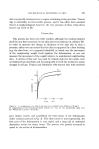
468 JOURNAL OF THE SOCIETY OF COSMETIC CHEMISTS of skin can now be related to the structures causing them with a reasonable degree of assurance. The purpose of this paper is to show how these relations between structure and function were arrived at, and to indicate how similar measurements might be clinically or pharmacologically applied. DEFINITION OF THE PROPERTY TO BE STUDIED Three distinct mechanical properties of skin have been defined: its immediate extension when tension is applied, its subsequent continuous extension while tension is maintained, and its gradual thinning under a local compression. Taking these in order, the first phenomenon is immediate and reversible and is therefore called an elastic extension. The second is gradual and irreversible and has therefore been termed variously viscous extension, viscous slip, or creep. The third is also irreversible in the sense that removal of the force does not restore the status quo ante and is not a true compression since there is no gas present, skin must be virtually in- compressible. It is actually a movement of fluid out from under the com- pressing force, and has therefore been termed viscous flow. It is virtually impossible to obtain completely reversible elastic pheno- mena, i.e. there is always some slip, and under high tension some viscous flow also occurs due to internal compression (2). Thus in practice the three properties cannot be completely separated, but in theory they represent different phenomena, which can be adequately isolated by appropriate experiments. EMPIRICAL STUDY OF THE MECHANICAL PROPERTIES Elastic extension This property has been widely studied. A large variety of extensometers have been employed, some designed specifically for the purpose (3, 4). These devices work with excised skin cut in the form of a strip similar results can be obtained from discs of skin subjected to a uniform pressure (5, 6). In principle it is desirable that the measurement should be instan- taneous in order to avoid viscous slip, but in practice measurements have usually been taken some seconds after the extension, or during continuous extension at a rapid rate. Although this does allow some viscous slip (7) most of the deformation is elastic and the results obtained by different observers show considerable agreement.
Purchased for the exclusive use of nofirst nolast (unknown)
From: SCC Media Library & Resource Center (library.scconline.org)