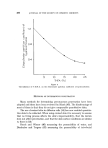
482 JOURNAL OF THE SOCIETY OF COSMETIC CHEMISTS the general problem of contact dermatitis, and in this context it is important to differentiate between any primary and irritating effect of cosmetics (fortunately rare) and a true allergic response. The essential difference is brought out by Von Pirquet's definition of allergy. In other words, the nature of the response of the skin is qualitatively different in an allergic reaction as compared with an irritant reaction. Secondly, there is a quantitative difference. Several substances can cause both primary irritation and allergic contact dermatitis. In the first instance, the concentration of material required to produce a reaction will be about the same for all members of the exposed population. In the latter instance, however, the threshold of response of those unfortunate selected few of the population who become sensitive is very much lowered. For example, the material which may cause primary irritation to the majority of people in a concentration of 1% is liable to cause an allergic reaction in those who become sensitised in concentrations of 100 or 1000 times less. It therefore behoves us to choose our concentration of material for patch testing with extreme caution. However, formal patch tests to cosmetics are often negative because of the low level of sensitivity induced and experimental exposure to the product may be necessary for proof. Frequently the suf- ferer has confirmed the diagnosis in this way for herself. Patch tests with soaps are also difficult to interpret because soaps themselves have a mild primary irritating effect, and the concentration of the sensitiser in the soap may be very low. It is fortunate that, in general, the site of the eruption be it urticarial (Type 1 hypersensitivity) or erythematous, scaly or frankly vesicular (Type 4) reactions usually gives a sufficiently clear clinical guide as to the offending material, e.g. eyelids- powders, creams, eyeshadow, mascara (or spectacles!) lips - lipstick, toothpaste (or dentures!). Nevertheless, it must be realised that allergens may be carried by the fingers and give rise to facial eruptions. This has been reported particularly in relation to nail varnish which may cause facial eruptions although the fingers themselves may be free. The cosmetologists' nightmare, however, is to assess the effects of intro- ducing new materials into cosmetics because it is very difficult to assess whether these are likely to give rise to allergic reactions. One is continuously asked how one can assess the potential sensitization properties of any one material. The answer is that it is almost impossible. There are, however, certain hints which one may go by. Firstly, if the material is likely to combine avidly with protein the chances of it being a sensitiser are high. If

CONTACT ALLERGY 483 its structural formula is close to a known sensitiser in this respect the chances are even greater. Rook, Wilkinson and Ebling (3) give a compre- hensive list of known sensitising agents. It is sometimes suggested that animal experimentation should be used but this is unfortunately of very limited value. It is true that guinea-pigs can be sensitised to a wide range of chemical substances and any potential cosmetic which might be suspected of being a sensitiser could be applied to guinea-pigs and tested in this way. However, the fact that application to the guinea-pig results in no hypersensitivity cannot be taken to mean that humans will respond in the same way, and one is inevitably forced into some form of limited user trial. Sometimes, repeated, so-called prophetic patch tests on volunteers is advocated, but again this will detect only the most potent of sensitisers or those sensitised by other means, and it is not without ethical objections. The basic problem is that even with potent sensitisers one expects only perhaps 1 in a 1000 people to become sensitised in the normal course of events. If care and experience are used to select the ingredients of cosmetics, only the feeblest of sensitisers will escape the net and this implies that perhaps only 1 in 100,000 or less is susceptible. No form of artificial system can be expected to detect this level of occurrence. CONCLUSIONS Finally, I should like to pay a tribute to the cosmetic and toilet pre- paration industry. In spite of the widespread and increasing use of such preparations and in spite of the improvements in them which recent years have brought about, there is no evidence of any increase in the incidence of sensitisation. The amount of trouble which they cause is really remarkably small and I have no doubt that this is due to the constant vigilance of the manufacturers. (Received: 1st August 1968) REFERENCES (1) Von Pirquet, C. Miinch. Med. Wochenschr., 30 (1906). (2) Gell, P. G. H. and Coombs, R. R. A. In Clinical aspects of immunology, Chapter 13 (1963) (Blackwell, Oxford). (3) Rook, A., YVilkinson, D. S. and Ebling, F. J. G. Textbook of dermatology, 9,: Appendix 1. (1968) (Blackwell, Oxford). DISCUSSION DR. D. SPRINT: You state that patch tests •vith soaps are difficult to interpret because soaps themselves have a mild primary irritating effect and the concentration
Purchased for the exclusive use of nofirst nolast (unknown)
From: SCC Media Library & Resource Center (library.scconline.org)