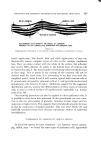
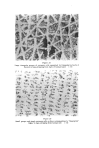
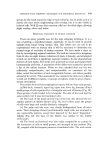
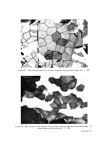
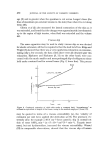
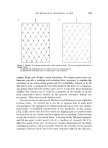
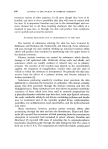
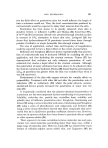
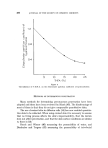
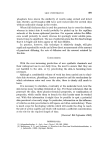
THE MECHANICAL PROPERTIES OF SKIN 473 Figura 4 Models of collagen meshworks which contain slack. The arrows mark direction ooe Langer's lines. 21, meshwork with fibres free to rotate but not to slip at joints. B, meshwork with fibres free to rotate and to slip at joints. explain Ridge and Wright's stress-relaxation. The simple model does not, however, provide a resisting and restoring force, necessary to explain the curvature of the stress-strain graph and its reversibility. Gibson et al {2) did insert such a component into their model in the form of a compress- ion spring which held the meshes open, but it is not clear what structural validity this concept has it could be a property of the elastin, or of the local compressive forces exerted on the ground substance during the movement. This subject needs further study. The slower viscous slip seen by Harkness and Harkness is not explicable in these terms. To account for it one has to suppose that at some level of organisation the aggregates of collagen molecules move past one another irreversibly. A simplified consideration of the mechanics of this system [Fig. $ (t3)• shows that the fibres which are slipping past one another must be very close to one another and in a highly viscous medium if this were not so the slip would be very much faster. 1 cm long fibrils 100 nm in diameter and 10 nm apart would need to lie in a medium of viscosity 50 P to allow the speed of slip seen. As these are realistic dimensions for the fibrils of collagenous fibres, and a reasonable value for the viscosity of the ground substance between them, this is the most probable origin of the slip seen.

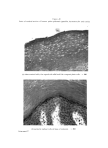
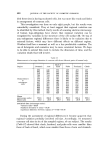
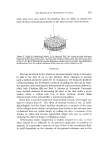
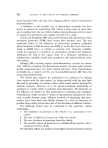
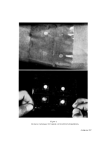
474 JOURNAL OF THE SOCIETY OF COSMETIC CHEMISTS (o) Set i i / -Velocity v Set I Set n / (b) Rods of set i+l-•"•0• h-2r o, s,,, o Figure 5 Model of slipping collagen fibres. They are assumed to move at a constant velocity [for details see (6)]. Presumably the histologically-observable bands of fibres do not slide past one another because they effectively form a continuum from one end of the tissue to the other, as indeed has been assumed in the explanation of elastic extension. Viscous flow is accounted for in terms of movement of the ground substance, and not of the fibrous matrix. Sections taken through a region of compressed skin show that the dermis is greatly reduced in thickness and the collagen fibres are closely packed together under the pressure whereas in the adjacent region the fibres are parted and the dermis is thicker than normal some fluid flow has occurred between the two regions. Once again simple model-building suffices to give an adequate description of the phenomenon. If one imagines that the ground substance has to flow out through restricted channels in local regions, and then passes easily to the outside of the compressed area (Fig. 6), the mathematical solution for the resultant time-course of deformation qualitatively resembles that actually seen (Fig. $), and with reasonable values of the parameters a good quantitative fit can be obtained (113). The process is not strictly speaking reversible, but massage will cause a return flow, by applying an opposing pressure gradient. It is to be hoped that these elementary models of the mechanical properties of the skin will be further tested by experiment as the present data are so scanty it is extremely likely that they will have to be modified
Purchased for the exclusive use of nofirst nolast (unknown)
From: SCC Media Library & Resource Center (library.scconline.org)