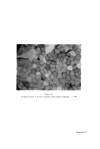
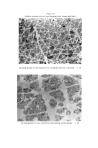
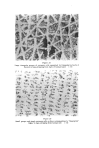
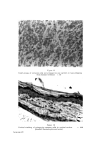
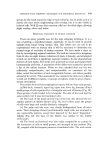
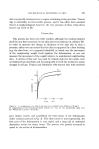
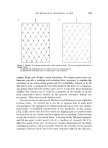
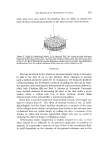
THE MECHANICAL PROPERTIES OF SKIN 477 observable collagen fibres lie along the lines of pre-existent force. Do you not think that in the light of what has been said about collagen, this could be put that the strains in the collagen can dictate the pattern of histological staining? In other words, that the collagen fibres are an artefact of histology, and if you then accept the concept that collagen is a gel, how will this fit in with your difficulties in the next paragraph? THE LECTURER: This is a long-standing controversy. The evidence concerned does not come from my work, but, as I understand it, during stress one sees in fixed tissue, a great many more "fibres" cut in cross-section across the line of stress than along it. This is plain observation and is not, I think, controversial. The controversy is whether or not these optically-observable fibres were produced on fixation. I would suggest that the difference between stressed and unstressed tissue can hardly be due to fixation, since the stress was applied, and I believe removed, before fixation. A further point is that the orientation of fibrils is also seen within the electron microscope, i.e. the appearance of fibres in the optical micrographs represents a preferred orientation of the fibrils. While the parallel aggregation of these fibrils into discrete fibres with spaces between them may be an artefact, it is hardly likely that the change in preferred orientation of the fibrils under stress is one. MR. 1NI. j. VAN ABBI•: I would have thought you could get just the sanhe effects with the electron microscope as with the optical microscope. THE LECTURE•: The optical microscope can give artefacts about things shrinking, hence this long-standing controversy about gelation. The electron microscope is, however, not giving artefactual fibrils they can also be observed in X-ray diffraction of fresh tissue, and are aggregates of the tropocollagen molecules, some 50nm across. If I can see these orientated in one way when unstressed, and in another when stressed, then I feel justified in saying that they turned round. DR. T. J. ELLIOTT: What are your opinions on the application of mechanical forces to the skin, as conducted by the forms of vibro-massage or massage creams? Are these likely to have any permanent effect upon the area of the skin that we are interested in? THE LECTUre R: I know nothing specifically about vibro-massage. In general terms, however, a sufficiently strong vibration should set up the compressire flow of ground substance which I have discussed. Tile channels through which this fluid flows, even if they only exist transi•orily, are prestonably liable to alter if they are ex•ensively used. One therefore might suppose that vibro-massage makes the ground substance flow more readily. I[I might make a specific suggestion: the co•npression method which I have mentioned can be readily and simply applied to a patient in vioo, and you could use it to see whether vibro-massage had, in [act, increased ease of ttow on compressiou.

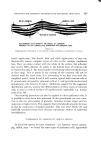
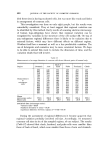
,]. Soc. Cosmetic Chemists 20 479-485 (1969) ¸ 1969 Society of Cosmetic Chemists of Great Britain Contact allergy C. N. D. CRUICKSHANK* Presented at the Symposium on "Skin", organised by the Society of Cosmetic Chemists of Great Britain, at Eastbourne, Sussex, on 19th November 1968. STnopsis--The modern concepts of the allergic skin reaction have been defined and illustrated. In relation to cosmetics, Type 1 (urticarial) and Type 4 (delayed) reactions are of importance. The problems of dsfining an allergic reaction and predicting the allergenic nature of chemicals and natural substances are discussed. There are few words more abused by the medical profession and by the layman alike than 'allergy', and it is important therefore to define carefully what is meant by allergy and the various reaction patterns which may be manifested in the skin as a result of an allergic reaction. Allergy was defined originally by Von Pirquet (1) as a "changed re- activity of the tissues to an agent to which the subject had previously been exposed". Thus, there were two basic elements in the reaction the agent known as the allergen and the state of altered response (allergy) following a second or multiple exposure. This basic concept covers all forms of allergic reaction. In view of the frequent mis-use of the term 'allergy' Gell and Coombs (2) have returned to Von Pirquet's original concept and devised a new and rational classification, based essentially upon the four basic allergic reaction patterns. These are defined as follows: TYPE 1 HYPERSENSITIVITY The Type 1 reaction corresponds to what is commonly known as local *Medical Research Council Unit for Research on the Experimental Pathology of the Skin, University of Birmingham. 479
Purchased for the exclusive use of nofirst nolast (unknown)
From: SCC Media Library & Resource Center (library.scconline.org)