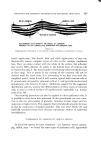
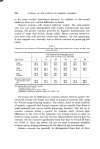
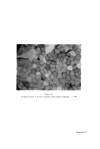
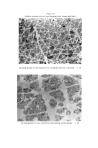
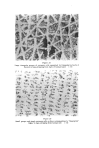
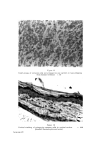
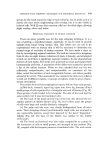
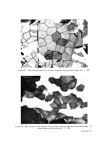
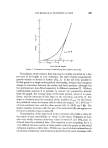
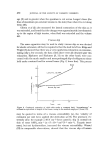
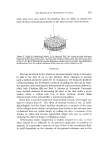
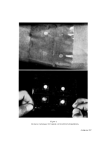
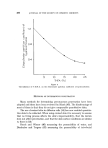
THE MECHANICAL PROPERTIES OF SKIN 475 when they have been tested. Nevertheless they do suffice to explain the most obvious mechanical properties of the skin in terms of its structure. Figure 6 Model of compressed dermis. It is supposed that the viscous ground substance moves with difficulty from within the individual stacks of plates, and then easily out from under the total compressed region. The equation of motion derived is that the compression x=ho(1 - (1 + •t)-•) where [• is a constant dependent on the viscosity of fluid and dimensions of the system ho is the original thickness of the tissue [for further details see (6)]. OUTLOOK The big drawback to the clinical or pharmacological study of extension in skin is the lack of an in vivo method. Three attempts to provide such a method should be noted Dr. R. Grahame at the Kennedy Institute of Rheumatology has developed a method of pulling the skin up by nega- tive pressure, and measuring the deformation for a given pressure difference, while both Vlasblom (20) and Prof. S. Shuster at Newcastle University have devised methods of measuring the twist of the skin under a given torsion about a vertical axis. One of these methods should make clinical study of skin extensibility a practical proposition. Given that a practical method of measurement existed, what might one hope to extract from it? The effect of extreme tension is not, in itself, physiological, but the elastic modulus should give a measure of the state of the collagen in the dermis and perhaps show earlier or less extreme cases of elastosis than are visible simply by pulling the skin. A measure of the tension at which slip became appreciable might xvell also be useful in studying the effect of drugs on collagenous tissue. Deformation under compression is readily measured in vivo, so that there should be no difficulty in its practical application on patients or animals. It is primarily a measure of ease of flow of the intradermal fluid, in itself dependent on the viscosity of the ground substance and on the

476 JOURNAL OF THE SOCIETY OF COSMETIC CHEMISTS separation of the fibrous matrix (hence the easy flow in oedema, when the fibres are parted). It is possible that application of a simple mechanical test might supplement the diagnostic skill of the physician's impressed thumb, and also might be useful in assessing the effects of drugs on the skins of animals. In sum, these are largely unexplored techniques. The basic essentials of the processes are known, so that it should be possible to make meaningful clinical or pharmacological measurements. (Received: oeOth August lt?6'8) REFERENCES (1) Rothman, S. Physiology and biochemistry of the skin (1954) (University Press, Chicago). (2) Gibson, T., Kenedi, R. M. and Craik, J. E. Brit. J. Surg., õ9, 764 (1965). (3) Harkness, M. L. R. and Harkhess, R. D. J. Physiol., 148 524 (1959). (4) Ridge, M.D. and Wright, V. Med. Biol. Engng., 4 533 (1966). (5) Dick, J. C. J. Physiol., 119, 109. (1951). (6) Tregear, R. T. Physical functions o. fskin (1966) (Academic Press, London). (7) Ridge, M.D. and Wright, V. Biorheology, 9, 67 (1965). (8) Rollhauser, H. Gegenbauers Morph. Jb., 00 9.49 (1950). (9) Ridge, M.D. and Wright, V. Engineering, 199 363 (1965). (10) Ridge, M.D. and Wright, V. J. Invest. Dermatol., 415 341 (1966). (11) Harkness, M. L. R. and Harkness, R. D. Nature, 1811 1821 (1959). (12) Fry, P., Harkhess, M. L. R., Harkness, R. D. and Nightingale, M. J. Physiol., 1154 77 (1962). (13) Wenzel, H. G. Zentr. ,,Illgem. Pathol. Phathol. ,4nat., 85 117 (1948). (14) Schade, H. Z. Exptl. Path. Ther., II 369 (1912). (15) Kirk, E. and Kvorning, A. S. J. Gerontol. 4 273 (1949). (16) Tregear, R. T. and Dirnhuber, P. J. Invest. Dermatol., 45 119 (1965). (17) Cowan, P.M., North, A. C. T. and Randall, J. T. Syrup. Soc. Exptl. Biol., 9 115 (1955). (18) Craik, J. E. New Scientist, $1 88 (1966). (19) Cox, H. T. Brit. J. Surg., 9,9 234 (1942). (20) Vlasblom, D.C. Skin Elasticity (1967) (Doctoral thesis, Utrecht University). DISCUSSION PROFESSOR F. J. EBL1NG: Nothing was said about elastic fibres. Could we have a note about this? T}m LECTUI•Ea: I kno•v nothing certain about the role of elastic fibres. However, it is evident that the extension of skin is elastic, even at low degrees of extension xvhere all the collagen fibres have not been pulled out taut. If one assumes a meshwork hypothesis, then something has to pull the mesh back to its original angle when the stress is removed. This restoring force could conhe from elastic fibres running across the meshwork, and hence strained by a much greater percentage than the overall strain on the skin, or it could come from local compression of the tissue. More work is needed before one can decide between these suggestions. Mi•. N.J. VAN A•eg: I should like to refer to page 472, particularly the tniddle paragraph and the first sentence, where you say that most of the histologically-
Purchased for the exclusive use of nofirst nolast (unknown)
From: SCC Media Library & Resource Center (library.scconline.org)