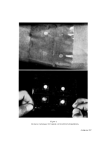
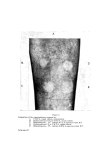
CONTACT ALLERGY 481 cells of the lymphoid-monocyte series. The allergy is confirmed by the intradermal injection of the suspected material into the skin and it gives rise to "a delayed skin reaction". This is an erythematous area of induration reaching a maximum some 24-48 h after the injection and subsequently fading within the next fe•v days. Occasionally the reaction is delayed for as long as a week. In the case of contact allergens the confirmation is made by applying a patch test and this is a procedure which must be executed and interpreted with considerable caution. The allergen is applied to the surface of the skin usually in the form of a lint soaked patch, covered with some impermeable dressing such as Cellophane. It is kept in contact with the skin for 48 h before removal unless the subject complains of severe irritation. A positive result is shown by the appearance of erythema and induration which con- forms to the outlines of the patch applied. If the subject is extremely sensitive, or if rather a high concentration is used, vesiculation at the site may also occur. In some instances light is necessary to mediate the allergic reaction- the photoallergic reaction. This can occur if photons catalyse the conversion of a non-allergic chemical into one which will combine with protein to form a true sensitiser, or when photons facilitate the union of substances with protein to form a sensitiser. This type of reaction must be distinguished from the phototoxic reaction. In this instance absorption of photons leads to electron excitation and the formation of free radicles which can react with the tissues causing liberation of inflammatory metabolites. A further type of allergic reaction which is considered to be a sub-group of Type 4 hypersensitivity is the allergic granulomatous reaction which has recently been shown to occur following the prolonged use of zirconium in deodorant sticks. It was noted that after several weeks of application to the axilla of deodorant sticks containing zirconium, subcutaneous nodules appeared in a proportion of the users, and in those subjects it was noted that minute amounts (as little as 0.2 •g) of sodium zirconium lactate injected into the upper dermis caused local granulomata to arise after about 6-8 weeks. This was shown to be clearly an allergic reaction, partly because of the histological nature of the lesion, and also because beryllium salts were without effect in these patients, and lastly the fact that con- tinuous exposure to zirconium reduced the time of development of the granuloma to as little as 2 weeks. I have mentioned that contact allergy to cosmetics is a special case of

482 JOURNAL OF THE SOCIETY OF COSMETIC CHEMISTS the general problem of contact dermatitis, and in this context it is important to differentiate between any primary and irritating effect of cosmetics (fortunately rare) and a true allergic response. The essential difference is brought out by Von Pirquet's definition of allergy. In other words, the nature of the response of the skin is qualitatively different in an allergic reaction as compared with an irritant reaction. Secondly, there is a quantitative difference. Several substances can cause both primary irritation and allergic contact dermatitis. In the first instance, the concentration of material required to produce a reaction will be about the same for all members of the exposed population. In the latter instance, however, the threshold of response of those unfortunate selected few of the population who become sensitive is very much lowered. For example, the material which may cause primary irritation to the majority of people in a concentration of 1% is liable to cause an allergic reaction in those who become sensitised in concentrations of 100 or 1000 times less. It therefore behoves us to choose our concentration of material for patch testing with extreme caution. However, formal patch tests to cosmetics are often negative because of the low level of sensitivity induced and experimental exposure to the product may be necessary for proof. Frequently the suf- ferer has confirmed the diagnosis in this way for herself. Patch tests with soaps are also difficult to interpret because soaps themselves have a mild primary irritating effect, and the concentration of the sensitiser in the soap may be very low. It is fortunate that, in general, the site of the eruption be it urticarial (Type 1 hypersensitivity) or erythematous, scaly or frankly vesicular (Type 4) reactions usually gives a sufficiently clear clinical guide as to the offending material, e.g. eyelids- powders, creams, eyeshadow, mascara (or spectacles!) lips - lipstick, toothpaste (or dentures!). Nevertheless, it must be realised that allergens may be carried by the fingers and give rise to facial eruptions. This has been reported particularly in relation to nail varnish which may cause facial eruptions although the fingers themselves may be free. The cosmetologists' nightmare, however, is to assess the effects of intro- ducing new materials into cosmetics because it is very difficult to assess whether these are likely to give rise to allergic reactions. One is continuously asked how one can assess the potential sensitization properties of any one material. The answer is that it is almost impossible. There are, however, certain hints which one may go by. Firstly, if the material is likely to combine avidly with protein the chances of it being a sensitiser are high. If
Purchased for the exclusive use of nofirst nolast (unknown)
From: SCC Media Library & Resource Center (library.scconline.org)