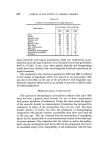
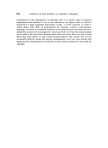
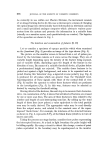
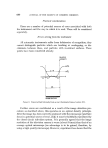
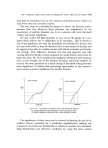
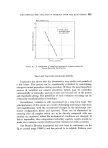
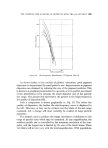
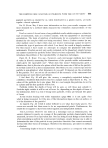
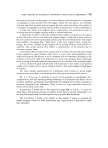
TttE PARTICLE SIZE ANALYSIS OF PIGMENTS WITH THE QUANTIMET ROSIN- RAMMLER AXIS MANUAL COUN.r 'QUAN'rlME'r' COUNT 'MULLARD' COUNT 100 1000 PARTICLE DIAME7ER Figure 12. A comparison of visual and automatic counters using the Rosin-Rammler distribution. Short and long term instrument stability Experience has shown that the Quantimet is very stable over periods of a few hours. This period can be considerably extended by maintaining adequate control procedures during operation. Of these, the most important sources of variation are camera sensitivity (which may be controlled automatically or manually, and can in any case be read out on the meter) and threshold setting. The possibility of such variation occurring can be reduced by standardization of technique. Nevertheless, variation is still experienced on a long term basis. The principal source of this occurs as a result of changing microscope objectives and magnification, with the necessitated changes in the microscope con- denser configuration (focus and aperture). These can be eliminated by ensuring that all samples which are to be directly compared with one another are measured before the instrumental conditions are changed. If this is impossible, then comparisons including separate results should be made via a common control which has been evaluated on both occasions. The Plastics Division instrument has now been in continuous use for 2} yr (actual usage 2 000 h) and has proved to be reliable. Failures were

684 JOURNAL OF THE SOCIETY OF COSMETIC CHEMISTS experienced during installation, but these were attributable to the rigours of a new application. Some further trouble was experienced approximately 24 months later, when a new television camera was installed. The old camera tube (1 700 h old) had not failed, but i•nage quality had deterior- ated {both resolution and contrast). Errors arising from the sample The nature of the sample will have a considerable bearing upon the ease and accuracy with which it is evaluated. The predominant problems of discrimination have already been discussed in detail elsewhere (9-11). Other aspects, such as the opacity of the sample and the presence of dust, have also been described (13). The way in which the sample is representative of the material from which it was withdrawn is of paramount importance. To reduce the magni- tude of this error, more features must be examined, and they must be withdrawn from a greater proportion of the original. It is regrettable that on many occasions much emphasis is placed upon the exact evaluation of a sample without due regard for the accuracy with which it represents the whole (an excellent example is the conclusion drawn from single optical and electron photomicrographs). The magnitude of errors arising from unrepresentative sampling have already been examined (13, 14). SAMPLING AND THE PREPARATION OF SAMPLES The necessity for representative sampling is accepted by anyone in- volved in particle size analysis. If we are going to use an automatic optical means to achieve this end, additional conditions must be imposed. To avoid difficulties due to the inability of the computer logic to separate touching or overlapping particles from re-entrant surfaces, the particles must be well separated, and as regular in shape as possible. However, in attempting to facilitate the separation, or distribution, of particles, care must be exercised so as to avoid the dispersion of aggregates and agglomerates. The extent to which this is a problem will depend upon the type of sample being examined powders obviously give considerable difficulty as do liquid suspensions, but the problem does not arise when the particles are sus- pended in a solid matrix. For these reasons the type of specimen prepared for evaluation will vary, according to the morphology of the sample.
Purchased for the exclusive use of nofirst nolast (unknown)
From: SCC Media Library & Resource Center (library.scconline.org)