THE PARTICLE SIZE ANALYSIS OF PIGMENTS WITH THE QUANTIMET 685 Powder methods There are several methods by means of which a sample of powder may be dispersed, and mounted, to provide a suitable specimen. These include dispersion in a liquid of low boiling point. After spreading the suspension out onto, for example, a glass slide, the liquid evaporates leaving the powder behind. This is generally unsatisfactory due to the extensive flocculation/agglomeration caused by the evaporating liquid (the resulting surface tension draws the small particles into the vicinity of the large ones). The situation is only partly remedied by the inclusion of a binder such as collodion (15). Alternatively, the powder may be dispersed into a high boiling point liquid by gentle mixing. The liquid suspension is diluted if necessary to give a reasonable particle concentration on the microscope slide, and mounted under a cover glass. When a powder is relatively coarse, e.g. 50 pm and above, it can some- times be advantageous to dust the sample onto a glass slide. This does, however, introduce the possibility of errors due to fractionation with the finer portion of the size range being lost. However, none of these methods is completely satisfactory (16). Liquid suspensions These have already been described under the previous heading. The liquids are of relatively high boiling point, and the final concentrations must be kept sufficiently low to prevent overcrowding on the microscope slide. Solid suspensions From most points of view this is the most convenient form in which to handle pigment particle populations. The material may be easily sampled by taking thin sections from a convenient moulding, or alternatively the material may be extruded as thin film the population is not subjected to size fractionation, since all particles are retained irrespective of size changes in particle size distribution cannot take place the samples are easily obtained and handled. A number of strips of film, or microtomed thin sections are examined using one of several available magnifications. The samples are selected from various parts of the specimen, and several areas examined from each sample.

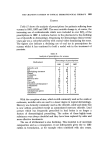
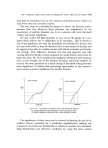
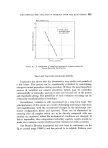
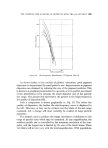
686 JOURNAL OF THE SOCIETY OF COSMETIC CHEMISTS This provides a satisfactory level of planned sampling, which, depending upon the number of samples and fields of view, is sufficient to give a representative evaluation. The method is described in more detail else- where (13). An examination of the procedure has shown the need to strike a balance between levels of sampling which are too low, (giving unrepresentative results) and those which are too high (giving high work loads). Statistical evaluation of results has shown that the examination of 40-50 fields of view is reasonably representative. The cumulative result can frequently account for 2-3 000 particles. This represents the number of resolvable particles in a known area of sample, which, depending upon the total magnification, can be as much as 6 cm 2. RESULTS The results of a size analysis with the Quantimet are obtained in the form of a cumulative oversize, number distribution. The range of sizes examined depends primarily upon the magnification chosen for the evalu- ation, as well as the nature of the sample itself. An example of an evaluation is given in Table I. This shows the observed size distribution (within the size range examined) of a series of pigment particle populations. The pig- ment is a full shade m-form, copper phthalocyanine (CI Pigment Blue 15). A total magnification of 380X was used for this examination. Table I Population Number of particles greater than 4pm 6pm 8gm 10gm i 14gm 18pm 28gm 38pm 1 2 266 943 472 121 46 30 7 1 2 1 137 423 166 82 27 13 3 0 3 395 140 56 28 : 7 3 0 0 4 381 169 77 48 ' 17 9 1 0 5 216 113 72 44 18 9 0 0 6 300 136 67 32 I 10 6 0 0 INTERPRETATION OF RESULTS The results of such a particle size analysis are usually evaluated graphi- cally. Thus by constructing size frequency and size cumulative frequency curves, the particle size distributions may be compared.
Purchased for the exclusive use of nofirst nolast (unknown)
From: SCC Media Library & Resource Center (library.scconline.org)