J. Soc. Cosmet. Chem. 23 447-470 (1972) ¸ 1972 Society of Cosmetic Chemistsof Great Britain The binding of small molecules to hair--I: The hydration of hair and the effect of water on the mechanical properties of hair M. M. BREUER* Synopsis---HUMIDITY has a major influence on hair sets. Experimental results suggest that water affects the mechanical properties of single fibres and these in turn strongly influence the set holding characteristics of hair tresses. The paper discusses the molecular mechanism of WATER BINDING to KERAT1N fibres and the role that hydration plays in the behaviour of single fibre properties. The binding of water appears to be a site binding process, i.e. interactions occur in stoichiometric ratios between the water molecules and the various hydrophilic groups of the protein (carboxylic, amino and peptide groups) and are governed by the mass action law. The effect of water on the mechanical properties of the fibre and, in particular, on its tem- perature-induced shrinkage (i.e. SUPERCONTRACTION) and the strain-stress curve can be adequately represented by means of a polymer-gel model. According to this model keratin is a semicrystalline (partially helical) cross-linked polypeptide network. The polypeptides, irrespec- tive of their conformations, are capable of binding water molecules, although the value of the binding constant depends on the conformation. The elasticity of the network, i.e. the retractlye force of the fibre, is determined by the free energy which is required to disorganize the helical regions into random conformations. Absorption of water changes this free energy of transition and thus affects both f, the elastic force, and T s, the shrinkage or melting temperature of the hair. The experimentally determined dependences of T s and f on humidity and off on tempera- ture can be interpreted in a consistent way using the conventional thermodynamic treatments developed for cross-linked semicrystalline polymeric networks. * Unilever Research Laboratory, 455 London Road, Isleworth, Middlesex 447

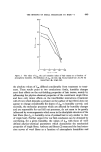
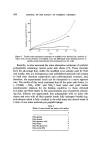
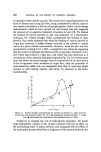
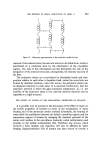
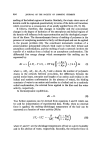
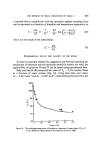
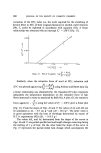
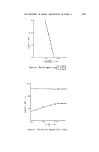
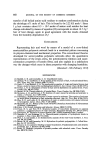
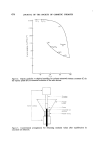
448 JOURNAL OF THE SOCIETY OF COSMETIC CHEMISTS INTRODUCTION Absorption of small molecular weight compounds by keratin plays an important part in many hair treatments. Consequently, considerable effort has been invested into the elucidation of the physical chemical principles which govern the binding of small molecules to keratin fibres in general, and to hair in particular. It is this author's view that most of the processes involved in keratin-small molecule interactions are now ads- quately understood, and the field is ripe for a general review. The present paper, which represents the first of a series intending to survey the current state of knowledge in the field of keratin-small molecule interactions, reviews the area of water binding to keratin fibres and the effects of hydration on the mechanical properties of hair. The paper treats four problems: firsfly, it describes the effect of humidity on the set-holding ability of hair tresses and highlights the role of single fibre properties in the curl retention processes then it reviews the state of knowledge regarding the molecular mechanism of hydration thirdly it describes a molecular model for keratin fibres which appears to account for most of their mechanical properties finally it discusses the molecular processes by means of which water influences, at least in the author's view, the mechanical properties of hair. THE EFFECT OF WATER ON THE PROPERTIES OF HAIR TRESSES AND OF SINGLE HAIR FIBRES Environmental humidity strongly affects the properties of both hair arrays and single fibres. To quote only one example, changes in humidity can destroy hair sets within a very short period of time. This point is well illustrated in Fig. 1, where Ic,•, the curl retention index for virgin and treated hair tresses are represented as a function of environmental humidity L•o- LB, (1) (lcR is defined as L•o where Lc• and L8 respectively denote the lengths of the hair tress in its uncutled form and after 3 h of exposure to humidity). It is interesting to note that the dependence of IcR on humidity for the three types of hair tresses examined, i.e. virgin hair, Pin Up © permed hair and Textra © treated hair* were found to be virtually the same, although * Pin Up © and Textra © are brand names for a thioglycolate-containing waving lotion and an after shampoo setting lotion containing a polymer, respectively. Pin Up and Textra are manu- factured by Elida Ltd, 43 Portman Square, London W. 1 and by Clynol Ltd, 22 Bond Street, London, W.1, respectively.
Purchased for the exclusive use of nofirst nolast (unknown)
From: SCC Media Library & Resource Center (library.scconline.org)