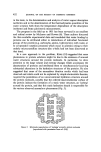
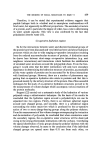
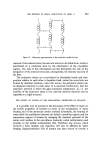
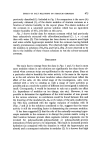
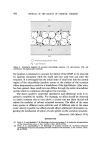
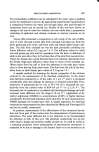
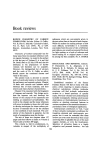
THE BINDING OF SMALL MOLECULES TO HAIR--I 463 S-S S-S ,• S-S S-S ' Figure 13. Schematic representation of the molecular model for hair. removal of the external stress, the network returns to its stable form, which is manifested on a molecular level by the reformation of the crystalline regions. The rate of this reformation process determines the rate of the dissipation of the internal stress and, consequently, the internal viscosity of the fibre. The polymeric chains are cross-linked by disulphide bonds and their position relative to each other is therefore fixed, unless the cross-links are broken by chemical reactions when this occurs, the polymeric chains can be displaced relatively to each other. It is assumed, furthermore, that the polymeric network is below the glass transition temperature, Tg, i.e. the mobility of the polymeric chain is low, and the network therefore can be regarded as a rigid structure. THE EFFECT OF WATER ON THE MECHANICAL PROPERTIES OF KERATIN It is possible now to proceed to the discussion of the effect of water on the tensile properties of keratins in terms of the mechanisms of water binding and of the molecular model outlined. Essentially, the binding of water shifts the equilibrium between the helical, crystalline regions and the amorphous regions of keratin by changing the chemical potential of the amino acid residues in the amorphous randomly coiled conformation and possibly in the helical conformation (34). Therefore, any process which involves a helix random coil transition will also be affected by water binding. Supercontraction (33) of keratin has been shown to involve a

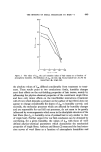
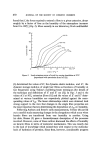
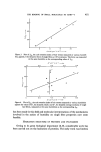
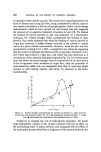
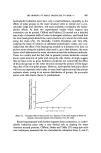
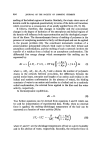
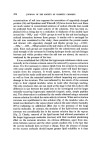
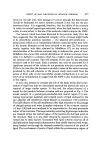
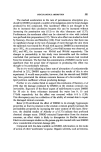
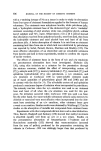
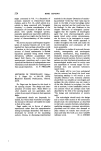
464 JOURNAL OF THE SOCIETY OF COSMETIC CHEMISTS melting of the helical regions of keratin. Similarly, the strain-stress curve of keratin could be explained quantitatively in terms of the helix coil transition which occurred as a consequence of an axially applied force (32, 35, 36). It follows, therefore, that changes in humidity and the concomitant changes in the degree of hydration of the amorphous and helical regions of the keratin will influence both supercontraction and the theological proper- ties of the fibres. The thermodynamic theory of melting of polymers in the presence of complexing materials is fairly well developed and can be applied to the present problem (34). The constituent monomeric residues of a semicrystalline polypeptide network bind water in both their helical and amorphous conformations, and the melting of such a network involves the transfer of n residues from a helical to an amorphous conformation. The differential free energy change which accompanies this melting can be expressed by: ( ) dG=u AHo-TAS o +RTlog +K•a +fAL dn (I) where u, AHo, ASo, AL, K, K•. f and a denote the number of polymeric chains in the network between cross-links, the differences between the partial molar heats, entropies and lengths of an amino acid residue in the helical and random conformation (in the absence of water), the binding constants of water to an amino acid residue in a helical and to a randomly coiled conformation, the external force applied to the fibre and the water activity, respectively. In thermodynamic equilibrium, dG = 0. (II) Two further equations can be derived from equations I and II which can be used for interpretation of experimental data. Firstly, when no external force is applied, the melting (shrinkage) temperature of the hair can be expressed as a function of water activity (39) by 1/T•_i/T•O_ R (1 +Kxa) AH-•- log 1 + K•.a' (III) where T s and Ts ø are the shrinkage temperatures of hair at a given humidity and in the absence of water, respectively. Secondly, the retractive force in
Purchased for the exclusive use of nofirst nolast (unknown)
From: SCC Media Library & Resource Center (library.scconline.org)