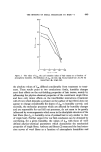
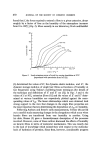
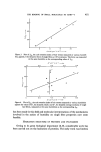
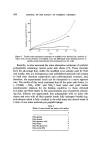
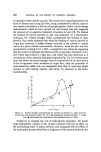
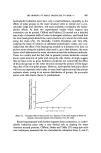
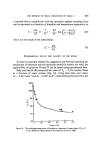
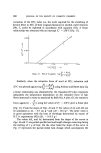
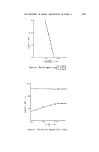
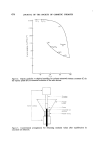
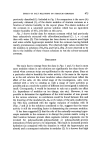
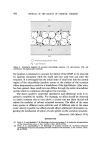
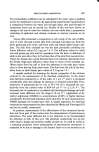
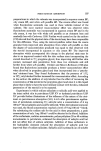
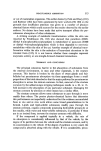
THE BINDING OF SMALL MOLECULES TO HAIR--I 467 • 20 30- o i i 0.05 O.lO Log U Figure 16. Plot off against log , 1 +K•.a 3.0 -- --b o o , 'u- 25% extension • 8% extension I I 0.50 0.35 0.40 [,_% --,.. Figure 17. Plot off as a function of (1 - TITsø).

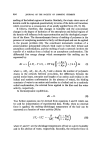
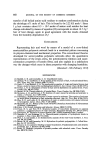
468 JOURNAL OF THE SOCIETY OF COSMETIC CHEMISTS transfer of all helical amino acid residues to random conformation during the shrinkage of 1 mole of hair. This is found to be 2.22 KJ mole 4. Since 1 g hair contains about 8.5 x 10 -a moles of amino acid residue the heat change calculated by means of equation (II) corresponds to about 18.7 J g4 hair of heat change, again in good agreement with the results obtained from the humidity dependence off CONCLUSIONS Representing hair and wool by means of a model of a cross-linked semicrystalline polymeric network leads to a consistent picture concerning its physico-chemical and mechanical properties. The conventional theories developed for semicrystalline polymeric networks allow the quantitative representation of the strain-stress, the potentiometric titration and super- contraction properties of keratin fibres, and also explain in a satisfactory way the changes which occur in these properties with changing humidities. (Received: 11th February 1972) (1) (2) (3) (4) 5) 6) (7) (8) (9) (10) (11) (12) (13) (14) (15) (16) (17) REFERENCES Baddid, C. B. and Cavendish, C. D. Unpublished results. Astbury, W. T. and Street, A. X-ray studies of the structure of hair, wool and related fibers. Phil. Trans. Roy. Soc. London A230 75 (1931). Huck, P. J. and Baddid, C. B. The mechanical properties of virgin and treated human hair fibres a study by means of the oscillating beam method J. Soc. Cosmet. Chem. 22 401 (1971). Treloar, L. R. G. Absorption of water by hair and its dependence on applied stress. Trans. Faraday Soc. 48 567 (1952). Breuer, M. M. Thermo-elasticity of keratin fibres. Trans. Faraday Soc. 58 2006 (1962). McLaren, A.D. and Rowen, J. W. Sorption of water vapour by proteins and polymers: a review. J. Polymer. Sci. 7 289 (1951). Valentine, L. Studies on the sorption of water vapour by polymers. The sorption of moisture by textile fibres in relation to their molecular structure. Ann. Sci. Text. Belg. 4 206 (1955). Eley, D. D. and Leslie, R. B. Adsorption of water on solid proteins with special reference to hemoglobin. Advan. Chem. Phys. 7 238 (1964). Berensden, H. J. C. Biology of the mouth 145 (1971) (American Association of Advancement of Science, Washington). Klotz, I. M. Protein hydration and behavior. Science 128 815 (1958). Frank, H. S. and Wen W-Y. Structural aspects of ion-solvent interaction in aqueous solutions: a suggested picture of water structure. Discussions Faraday Soc. 24 133 (1957). Kauzmann, W. Advances in protein chemistry 14 1 (1959) (Academic Press, London). Nemethy, G. and Scheraga, H. A. Thermodynamic properties of hydrophobic bonds in proteins. J. Phys. Chem. 66 1773 (1962). Watt, I. C. and Leeder, J. D. Stoichiometric analysis of the wool-water isotherm. J. Text. Inst. 59 353 (1968). Breuer, M. M. and Kennerley, M. G. Hydration of synthetic polypeptides. J. Colloid Inter- face Sci. 37 124 (1971). Schwarz, G. Co-operative binding to linear biopolymers. Fundamental static and dynamic properties. Eur. J. Blochem. 12 442 (1970). Rosen, D. Dielectric properties of protein powders with adsorbed water. Trans. Faraday Soc. 59 2178 (1963).
Purchased for the exclusive use of nofirst nolast (unknown)
From: SCC Media Library & Resource Center (library.scconline.org)