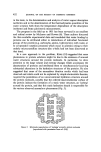
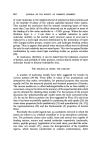
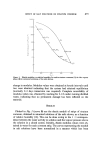
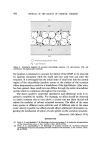
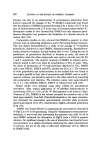
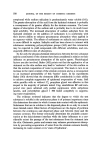
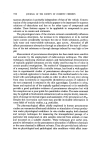
478 JOURNAL OF THE SOCIETY OF COSMETIC CHEMISTS cII CI2 O= Protein/polysaccharide matrix • =Lipid molecule Figure 4. Schematic diagram of corneum intercellular junction. CI, cell interior CM, cell membrane H, hygroscopic molecule. the junction is necessary to account for failure of the NMF to be removed by aqueous extraction while the small salt ions used here can enter the structure. It is envisaged that the initial entry of small ions into the central region of the intercellular junction occurs at the surface of the corneum where desquamation results in a breakdown of the lipid bilayer. After entry has been gained, these small ions can diffuse through the entire intercellular system which is continuous throughout the corneum. The above model is somewhat speculative and additional work is re- quired to establish its validity. For example, no effect should be observed on native corneum due to ions above a critical size but these should still reduce the modulus of solvent extracted corneum. The effect of the same ionic species at different water activities and of different salts at the same water activity (specific ion effect) should afford additional information re- garding the mechanism of action of such species on the corneum structure. (Received: loth March 1972) REFERENCES (1) Park A. C. and Baddiel, C. B. Rheology of stratum corneum I. A molecular interpretation of the stress-strain curve. J. Soc. Cosmet. Chem. 23 26 (1972). (2) Park, A. C. and Baddid, C. B. Rheology of stratum corneum II. A physico-chemical investigation of factors influencing the water content of the corneum. J. Soc. Cosmet. Chem. 23 36 (1972).

EFFECT OF SALT SOLUTIONS ON STRATUM CORNEUM 479 (3) (4) (5) (6) (7) (8) (9) (10) (11) (12) (13) (14) (15) (16) (17) (18) Higuchi, T. and Tillman, W. J. Stress-relaxation of stretched callus strips. Arch. Environ. Health. 11 508 (1965). Laden, K. and Morrow, R. Torsional measurements on skin. J. Soc. Cosmet. Chem. 21 417 (1970). Wildnauer, R. H., Bothwell, J. W. and Douglass, A. B. Stratum corneum biochemical properties. J. Invest, Dermatol. 56 72 (1971). Elfbaum, S. G. and Wolfram, M. A. Effect of dimethyl sulphoxide and other reagents upon mechanical properties of stratum corneum strips. J. Soc. Cosmet. Chem. 21 129 (1970). Crounse, R. G. Epidermal keratin: a re-evaluation. Nature (London) 200 539 (1963). Matoltsy, A. G. and Matoltsy, M. N. The membrane protein of horny cells. J. Invest. Dermatol. 46 127 (1966). Middleton, J. D. The mechanism of action of surfactants on the water binding properties of isolated stratum corneum. J. Soc. Cosmet. Chem. 20 399 (1969). Middleton, J. D. The mechanism of water binding in stratum corneum. Brit. J. Dermatol. 80 437 (1968). Mercer, E. H., Jahn, R. A. and Maibach, H. I. Surface coats containing polysaccharides on human epidermal cells. J. Invest. Dermatol. 51 204 (1968). Blank, I. H., Scheuplein, R. J. and Macfarlane, D. J. Mechanism of percutaneous absorp- tion. III. The effect of temperature on the transport of non-electrolytes across the skin. J. Invest. Dermatol. 49 582 (1967). Robinson, R. A. and Stokes, R. H. Electrolyte solutions 2nd ed. (1959). (Butterworths, London). Tanford, C. Physical chemistry of macromolecules 520 (1967) (J. Wiley and Sons Inc. London). Speakman, J. B. and Whewell, C. S. The action of potassium chloride on keratin. J. Text. Inst. 41 329 (1950). Alexander, P. and Hudson, R. F. Wool its chemistry andphysics 2nd ed. 219 (1963)(Chap- man & Hall Ltd, London). Middleton, J. D. Pathways of penetration of electrolytes through stratum corneum. Brit. J. Dermatol. 81 Suppl. 4 56 (1969). Scheuplein, R. J. and Morgan, L. J. 'Bound water' in keratin membranes measured by a microbalance technique. Nature (London) 214 456 (1967).
Purchased for the exclusive use of nofirst nolast (unknown)
From: SCC Media Library & Resource Center (library.scconline.org)