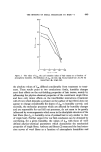
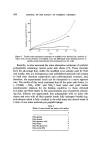
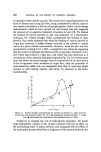
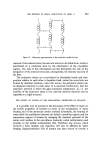
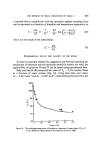
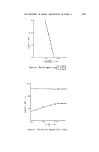
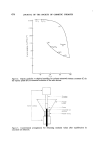
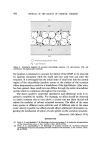
THE BINDING OF SMALL MOLECULES TO HAIR--I 465 a strained fibre in equilibrium with the externally applied extending force can be expressed as a function of humidity and temperature respectively by AHo (1-•? RT log (.1 +K•a) f- •'• q- A-•- 1 + K•a (IV) where use was made of the relationship: EXPERIMENTAL TEST OF THE VALIDITY OF THE MODEL In order to ascertain whether the suggestions put forward regarding the mechanism of hydration and the molecular model for keratin are valid, the applicability of equations III and IV can be tested using experimental data. Haly and Snaith (40) measured the value of Tm -- Ts for keratin fibres as a function of water content (Fig. 14). Using their data and values K• = 0.34 1 mole -• and Ks = 0.29 1 mole 4, determined previously from the 220 - 180 ,4ø I 120' I o 20 I I I I, 40 60 80 100 'Regoin'(%) Figure 14. The shrinkage temperature of keratin as a function of water regain (Tin= T s in our definition). [Reproduced with permission from ref. (40).]

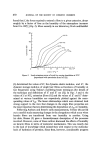
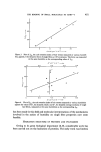
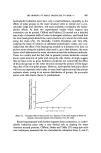
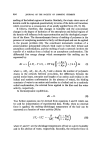
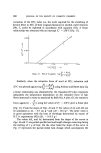
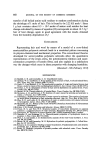
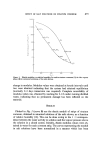
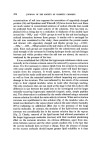
466 JOURNAL OF THE SOCIETY OF COSMETIC CHEMISTS variations of the 20• index (i.e. the work required for the stretching of keratin fibres to 205/o of their original extension) in alcohol-water mixtures (39), T s could be replotted in accordance with equation (III). A linear relationship was obtained with an intercept Ts ø = 250øC (Fig. 15). 2.40 •_o 2.20 x o• o o 2.00 1 0.02 0.04 O.OG 0.08 I,+,•,ol Log L'+•J ---'- FigureIS. PlotofTsagainst log(1-FK•a) 1 + K•a Similarly when the retractive force of wool at 20•o extension and 25øC was plotted against log ({ + K•a• + Kaa] using Astbury and Street data (2), a linear relationship was obtained (Fig. 16). Equation (IV) also represents adequately the temperature dependence on the retractive force of hair fibres immersed in water as measured by Bull (41). A plot off, the retractive T force, against (1 - Ts•-7) using the values of T• ø = 210øC gives a linear plot (Fig. 17). From the slopes of Figs. 16 and 17 the values of AL and AH can be calculated as AL = 0.7 cm g4 and AH = 20 J g4. The latter value is in good agreement with the heat of shrinkage determined by means of D.T.A. experiments (42) (AHo = 16.8 J g4. The values AHo and AL determined from the slopes of the curves in Figs. 16 and 17 are partial specific heat and length changes occurring during the melting of 1 g of hair. On the other hand the slope of the curve in Fig. 15 represents the partial molal heat change which accompanies the
Purchased for the exclusive use of nofirst nolast (unknown)
From: SCC Media Library & Resource Center (library.scconline.org)