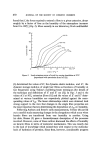
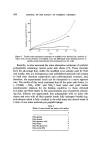
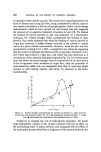
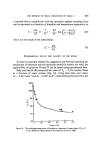
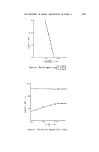
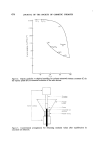
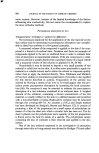
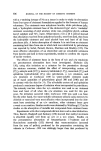
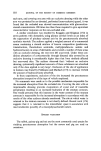
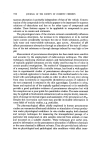
THE BINDING OF SMALL MOLECULES TO HAIRmI 453 On the basis of Frank and Wen's (11) work, Kauzmann (12) assumed, on the other hand, that water is a mixture of flickering clusters (hydrogen bonded aggregates of water molecules) and monomeric water molecules and that a protein molecule, with its many hydrophobic side chains, induces a higher probability of cluster formation in its immediate neigh- bourhood (i.e. it shifts the equilibrium between aggregates and monomeric water towards the direction of clusters). These basic ideas led then to Nemethy and Scheraga's (13) work who put the flickering cluster model of water on a quantitative footing. Nemethy and Scheraga's work opened up a great deal of new interest in water-solute interactions and a tremendous amount of work has been carried out during the last decade both on the structure of liquid water and on the structure of aqueous solutions. The expression 'hydrophobic interactions' became a household word of the biochemical and biophysical literature, so much so that it is difficult to find a paper in the protein literature today which does not refer in some part of its discussion to hydrophobic bonding or hydrophobic hydration as an interpretation of any unexplained phenomenon. Binding of water to sites During recent years new experimental results have become available which suggest that the interactions of the polar groups of proteins with water play a much more important part in determining the hydration structure than'was thought previously. In recent years Watt and Leeder in a series of papers [for summary see (14)] reported the measurement of adsorption isotherms of water on wool samples in which the various functional groups of the protein were systematically blocked by means of specific chemical reagents. Comparing the isotherms of modified samples with those of virgin wool samples from the same batch, differential water adsorption isotherms could be constructed which represented interactions of water molecules with particular functional groups (Fig. 6). In this way the adsorption isotherms of carboxylic groups, amino groups, hydroxyls (both aromatic and aliphatic) and of the backbone peptide groups were determined. The results of these measurements showed that charged carboxylic groups (COO-) complex with two water molecules, the charged amino groups with three, aliphatic hydroxyl (serine) with one and aromatic hydroxyl groups (tyrosine) with two water molecules. The adsorption isotherm of the peptide group, obtained by difference, extrapolated to a 1: 1 molar ratio of water to peptide group.

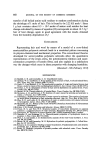
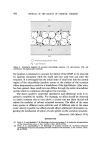
454 JOURNAL OF THE SOCIETY OF COSMETIC CHEMISTS õ •o .-- -- ! 0 20 40 60 80 I00 %rh Figure 6. Typical water adsorption isotherms of modified wool. Broken line, isotherm of virgin wool (a) the isotherm of modified wool (b) differential water binding isotherm of specific groups [reproduced with permission from ref. (14)]. Recently, we also measured the water adsorption isotherms of synthetic polypeptides containing various polar side chains (15). These materials have the advantage that, unlike the modified wool samples used by Watt and Leeder, they are homogeneous and well-defined materials with respect to both their chemical composition and conformational structure, and, therefore, the experimental result can be interpreted in a more rigorous way. The results of this work confirmed that all the polar side chains, i.e. (--COOH, --NH•, COO- and NHa +) bind water and yield similar stoichiometric relations for the binding equilibria to those obtained by Leeder and Watt (Table I). The measurements also revealed the interest- ing fact, hitherto not appreciated, that polypeptides with no polar side chains and even with all their peptide bonds fully hydrogen bonded (e.g. poly-alanine which is fully e-helical in the solid state) also absorb water in a ratio of one water molecule per peptide linkage. Table I Moles of water bound per amino acid residue Poly-glycine 1 Poly-alanine 1 Poly-glutamic acid 2 Poly-lysine 4 Poly-Na glutamate 3 Poly-lysine HBr 4
Purchased for the exclusive use of nofirst nolast (unknown)
From: SCC Media Library & Resource Center (library.scconline.org)