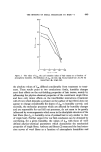
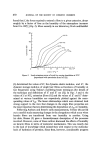
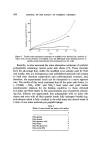
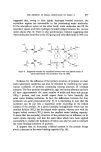
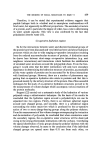
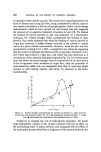
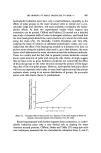
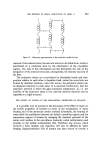
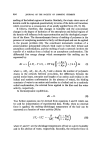
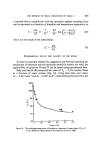
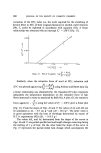
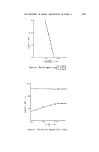
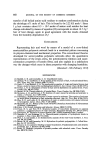
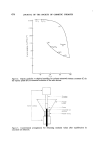
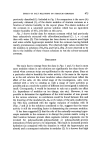
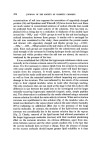
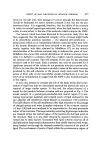
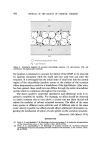
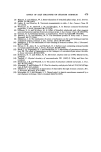
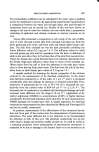
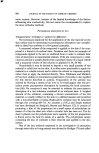
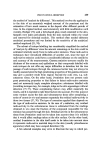
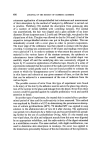
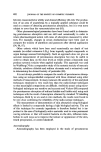
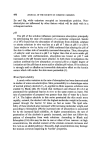
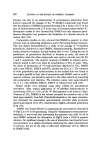
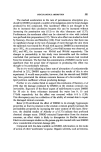
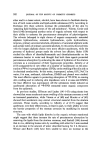
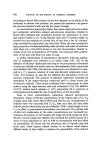
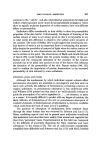
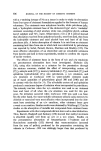
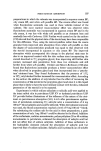
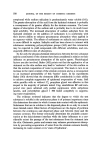
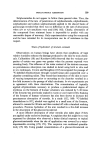
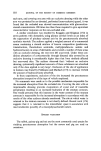
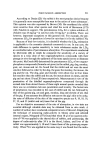
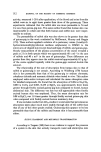
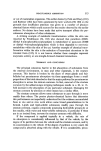
THE BINDING OF SMALL MOLECULES TO HAIR--I 457 suggested that, owing to their tightly hydrogen bonded structure, the crystalline regions are inaccessible to the penetrating water molecules. In the amorphous nylon on the other hand, water molecules can fill the interchain spaces and form hydrogen bonded bridges between the various nylon chains (Fig. 8). There is also spectroscopic evidence suggesting that water molecules bond first to the CO group and only afterwards to NH (21). %0 ...... .... .... " CO .... HN..,. '"'HN•.• 0 .... HN) S / Figure 8. Suggested formulae for complexes between water and peptide bonds of nylon [reproduced with permission from ref. (20)]. Evidence for the influence of the tertiary structure of proteins on their water adsorption isotherms can also be obtained by examining the water vapour isotherms of proteins containing varying amounts of e-helical contents. The four proteins lactoglobulin, egg- and serum-albumin and zein all have approximately the same number of acidic and basic side groups 100g 4 protein, and one would expect them to have basically the same water binding isotherms. In fact, the differences between the four isotherms are quite pronounced (Fig. 9). It is interesting to note that the isotherms can be put into a sequential order according to the helical content of the protein. At a given humidity lactoglobulin which has the smallest helicity (10•o) has the largest water uptake, whereas zein with the largest helical content (70•o) shows the smallest water binding capacity. It seems that the secondary structure of the protein has an influence on its water uptake capacity, and that the same ideas which have been applied successfully to explain the hydration of nylon can also be used to interpret the water binding isotherms of proteins. It appears that an increasing e-helical content in the protein brings about a decrease in the water binding capacity (Fig. 10).

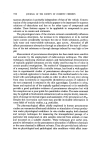
458 JOURNAL OF THE SOCIETY OF COSMETIC CHEMISTS 2.51 [•/•- lectog ---Serum olbumin FEgg (]lbumin 2,0 1.5 •""/• -Zein x / x / x / 0.5 x x/x x / x / Figure 9. 0.2 0.4 0.6 0.8 I0.0 rh Water adsorption isotherms of proteins with varying 0•-helical contents. [2, 10% O, 45% A, 30% X, 70%. Humidity at 25øC. ß -.-. X X X x•x, x. 0 25 50 75 I00 % a- helicol content Figure 10. Plot of water adsorption isotherms of proteins as a function of their 0•-helical content. •, 90 % humidity ¸, 80 % humidity X, 60 % humidity.
Purchased for the exclusive use of nofirst nolast (unknown)
From: SCC Media Library & Resource Center (library.scconline.org)