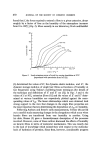
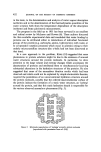
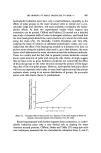
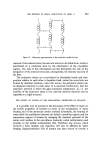
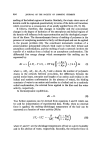
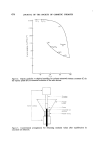
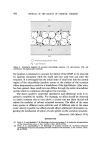
472 JOURNAL OF THE SOCIETY OF COSMETIC CHEMISTS corneum's cellular network (7). A different protein (8) constitutes the bulk of the cell membranes (• 65•) and other known components, which are ill-defined with regard to their position in the structure, include lipids (mainly cholesterol and phospholipids), water-soluble hygroscopic materials sometimes referred to as the natural moisturizing factor or NMF (these include simple peptides, organic acid salts and free amino acids) and poly- saccharides (9-11). A dual role has been established for the lipids. These substances reduce the rate of water transport through the corneum (12) and prevent the NMF from being extracted with water (9). The hygroscopics act as emollients by causing the corneum to retain water under dry environ- mental conditions. The role of the polysaccharides is ill-defined but they are probably involved in conjunction with the proteins of the cell junction in intercellular adhesion (11). In this communication, the effects of saturated solutions of salts on the elastic modulus of isolated strips of pigs' ear stratum corneum are described and the results discussed in terms of the crucial role of water in eftcoting changes in the mechanical characteristics of the material. By use of in- organic ions as simple models, for the hygroscopics, insight has been gained into the location of the NMF in the corneum structure and the types of interactions likely to occur between the hygroscopic materials and the corneum proteins. Reason is also given for the permanence of these water- soluble materials in the corneum. A model is proposed for the intercellular junction of the corneum in which, it is believed, the mechanical integrity of this material lies. EXPERIMENTAL The techniques employed for isolating intact sheets of stratum corneum from the skin of pigs' ears and for obtaining accurate elastic modulus values for this material, by means of the Instron extensometer, have been previously described (1). Narrow strips of stratum corneum were equilibrated in saturated solu- tions of the salts shown in Figs. 1 and 2 prior to obtaining their elastic moduli. Since errors due to buoyancy effects arose if the top clamp which is connected to the load cell of the Instron was in contact with the solutions, it was impossible to extend the corneum while it was totally immersed in the salt solutions. However, by use of the device shown in Fig. 3 it was possible to measure the elastic modulus of a corneum strip within 30 s of its removal from the solution exposures of up to 10 min produced no

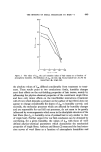
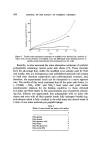
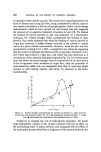
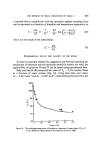
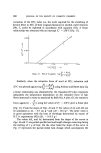
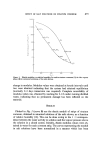
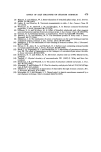
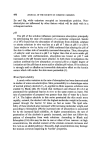
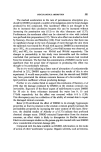
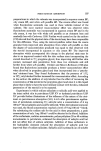
EFFECT OF SALT SOLUTIONS ON STRATUM CORNEUM 473 3 000 I000 300 I00 30 I0 H•O , I I 4•0 6•0 80 I O0 %rh Figure 1. Elastic modulus vs relative humidity for native stratum corneum (A) in the vapour phase (B) in saturated solutions of the salts shown. change in modulus. Modulus values were obtained at hourly intervals until two were identical indicating that the system had attained equilibrium (normally 2-3 days immersion was required). Complete reversibility of modulus values was obtained by washing for 2-3 h under running distilled water, indicating that no permanent damage has been inflicted on the material. RESULTS Plotted in Fig. 1 (curve B) are the elastic moduli of strips of stratum corneum, obtained in saturated solutions of the salts shown, as a function of relative humidity (13). This can be done owing to the 1: 1 correspon- dence between the water activity in solution and the vapour pressure above the solution in a closed system. Initially, elastic modulus values were ob- tained in water for each corneum strip. The curves representing the moduli in salt solutions have been normalized in a manner which has been
Purchased for the exclusive use of nofirst nolast (unknown)
From: SCC Media Library & Resource Center (library.scconline.org)