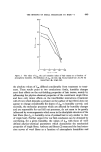
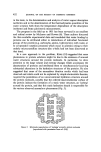
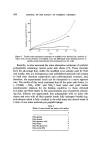
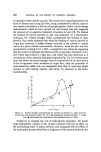
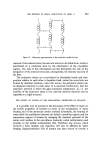
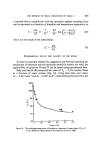
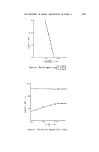
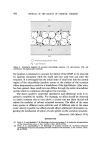
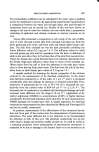
THE BINDING OF SMALL MOLECULES TO HAIR--I 461 hydrophobic hydration must have only a small influence, especially as the effects of polar groups on the water structure seem to extend over a con- siderable range and, therefore, will most probably overshadow the hydro- phobic effects. At least two experimental results which support this contention can be quoted. Clifford and Pethica (25) carried out a detailed mr study of chemical shifts of water in detergent solutions, and found that the ionic head groups disturb the water structure up to about the sixth atom along the chain (Fig. 12). Secondly, Corkill, Goodman and Tate (26), studying the heats of solution of alkylated polyethylene oxides, also con- cluded that the effect of the head group extends to a distance of at least six carbon atoms along the aliphafic chain and is, up to that distance, the main factor which determines the water structure around the surfactant molecule. These two results, and the fact that in general, protein molecules contain about equal amounts of polar and non-polar side chains, strongly suggest that (at least as far as gross hydration properties are concerned) the effect of the polar groups on the water structure around the protein will be larger than that of the non-polar groups. However, hydrophobic hydrafion effects will have an important role to play in some local regions around the protein molecule where, owing to an uneven distribution of groups, the non-polar amino acid side chains chance to predominate. -o oc 0,3 •.._• 0,2 • o 2 4 G 8 IO 12 Chain length of alkyl sulphate Figure 12. Chemical shift of water proton as a function of the chain length of dissolved aliphatic anion [reproduced with permission from ref. (25)]. Recent experimental work further supports these contentions, i.e. hydro- phobic hydration plays only a very limited role in shaping the water structure around proteins. Clifford, Oakes and Tiddy (27) using spin echo nmr techniques, measured the two characteristic relaxation times T• and T•

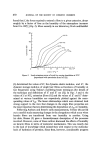
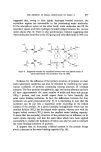
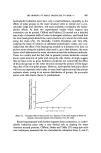
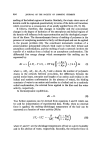
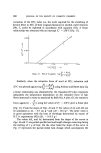
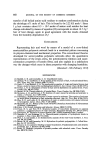
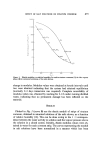
462 JOURNAL OF THE SOCIETY OF COSMETIC CHEMISTS of water molecules in the neighbourhood of polystyrene latex particles and in the lamellar D phase of the sodium caprylate-decanol-water system. They reached the conclusion that for systems containing layers of water more than 2 nm thick, all the effects observed can be explained in terms of the binding of a few water molecules to --COO- groups. Where the water thickness layer is 2 nm there is a marked reduction in water molecular mobility as the normal water structure ceases to exist and is replaced by a more rigid structure determined by the interaction of water with charged surface groups, counter ions, and hydrogen bonding surface groups. Thus, it appears that special water structure effects must be allowed for only for such relatively narrow water layers. This view has gained further confirmation by some recent light scattering studies on protein solvation (28). In conclusion, therefore, it can be stated that the hydration structure of keratin, and probably of other proteins, consists almost entirely of water molecules bound to discrete hydrophilic sites. THE MOLECULAR MODEL FOR KERATIN A number of molecular models have been suggested for keratin by various authors (29-34). These differ in many of the assumptions and abstractions they make nevertheless, for practical purposes they account equally well for the measured physical and chemical properties of keratin. The various models are in effect indistinguishable as far as their validity is concerned, owing to the limits in the accuracy of the experimental data which can be obtained for checking these models. For the purpose of the present discussion the 'polyelectrolyte gel' model seems the most convenient (Fig. 13). Its use for fibrous proteins was first suggested by Flory (31) and since then it has been successfully applied for explaining the acid uptake (35), the strain stress properties [both qualitatively (31) and quantitatively (36, 37)], the supercontraction (38) and the thermoelastic (5) properties of keratin fibres. Essentially this model regards hair as a polymeric network in which the chains are either in an e-helical crystalline or in an amorphous conforma- tion. The polymeric chains carry acidic, basic and neutral sites capable of binding cations, anions and neutral molecules respectively (carboxylic, amino, peptide groups). Application of an axial stress, provided the exten- sion does not exceed 15•, causes the disorganization of the crystalline regions, which become transformed to random conformations. After
Purchased for the exclusive use of nofirst nolast (unknown)
From: SCC Media Library & Resource Center (library.scconline.org)