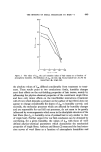
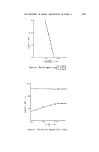
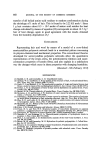
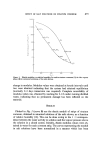
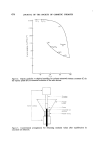
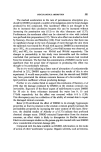
448 JOURNAL OF THE SOCIETY OF COSMETIC CHEMISTS INTRODUCTION Absorption of small molecular weight compounds by keratin plays an important part in many hair treatments. Consequently, considerable effort has been invested into the elucidation of the physical chemical principles which govern the binding of small molecules to keratin fibres in general, and to hair in particular. It is this author's view that most of the processes involved in keratin-small molecule interactions are now ads- quately understood, and the field is ripe for a general review. The present paper, which represents the first of a series intending to survey the current state of knowledge in the field of keratin-small molecule interactions, reviews the area of water binding to keratin fibres and the effects of hydration on the mechanical properties of hair. The paper treats four problems: firsfly, it describes the effect of humidity on the set-holding ability of hair tresses and highlights the role of single fibre properties in the curl retention processes then it reviews the state of knowledge regarding the molecular mechanism of hydration thirdly it describes a molecular model for keratin fibres which appears to account for most of their mechanical properties finally it discusses the molecular processes by means of which water influences, at least in the author's view, the mechanical properties of hair. THE EFFECT OF WATER ON THE PROPERTIES OF HAIR TRESSES AND OF SINGLE HAIR FIBRES Environmental humidity strongly affects the properties of both hair arrays and single fibres. To quote only one example, changes in humidity can destroy hair sets within a very short period of time. This point is well illustrated in Fig. 1, where Ic,•, the curl retention index for virgin and treated hair tresses are represented as a function of environmental humidity L•o- LB, (1) (lcR is defined as L•o where Lc• and L8 respectively denote the lengths of the hair tress in its uncutled form and after 3 h of exposure to humidity). It is interesting to note that the dependence of IcR on humidity for the three types of hair tresses examined, i.e. virgin hair, Pin Up © permed hair and Textra © treated hair* were found to be virtually the same, although * Pin Up © and Textra © are brand names for a thioglycolate-containing waving lotion and an after shampoo setting lotion containing a polymer, respectively. Pin Up and Textra are manu- factured by Elida Ltd, 43 Portman Square, London W. 1 and by Clynol Ltd, 22 Bond Street, London, W.1, respectively.

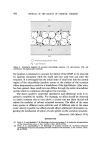
THE BINDING OF SMALL MOLECULES TO HAIR--I 80 6O • 40 2O I I I I ........... I,, 0 20 40 60 80 100 Figure 1. The value of IcR, the curl retention index of hair tresses as a function of atmospheric humidity. (For definition of IcR, see text.) O, Textratreated hair O, Pin Up treated hair O, virgin hair. 449 the absolute values of IcR differed considerably from treatment to treat- ment. These results point to two conclusions: firstly, humidity changes exert their effects on the curl-holding properties of hair tresses, mainly by influencing the physico-chemical properties of the constituent single fibres and have only minor effects on the interfibrillar interactions (treatment with Textra which deposits a polymer on the surface of hair fibres does not appear to change considerably the slopes of Ica vs humidity curves) and secondly, the molecular processes which are affected by humidity changes and are responsible for curl fall out processes, do not seem to be greatly influenced by re-arrangements which occur in the disulphide structure of the hair fibres (the IcR vs humidity curve of permed hair is very similar to that of virgin hair). Further support for our first conclusion can be obtained by correlating, for a given humidity, the values of Ica with those of well- defined physico-chemical parameters which characterize the mechanical properties of single fibres. Astbury and Street (2) measured the load exten- sion curves of wool fibres as a function of atmospheric humidities and
Purchased for the exclusive use of nofirst nolast (unknown)
From: SCC Media Library & Resource Center (library.scconline.org)