]. Soc. Cos•net. Chem., 25, 139-152 (March 1974) The Evaluation of Antiperspirant Efficacy--Influence of Certain Variables PAUL A. MAJORS, M.S., and joHN E. WILD, B.S.* Presented May 4, 1973, Seminar, Cincinnati, Ohio Synopsis-ANTIPERSPIRANT activity estimated by a GRAVIMETRIC PROCEDURE is discussed. The possible influence of several factors on observed EFFECTIVENESS are evaluated, namely, sweating rate, axilla treated, sweat collection conditions, and method of data analysis employed. Panelist-to-panelist variation in response is briefly discussed. INTRODUCTION Several systems have been employed by numerous investigators in evalua- ting antiperspirant activity. The simplest of these have been visual observation procedures (1-3). They are of value as screening procedures in which several potential antiperspirant agents can be simultaneously evaluated on the same panelists. A second type of evaluation is that which provides prec _se measure- ments of sweat output from limited areas of skin. The procedures of James (4) and Jenkins et al. (5) are two somewhat different examples of this basic method. Evaluations of this type provide precise measurements of sweat out- put however, the complexity of the method renders it impractical for evalua- tions on the relatively large number of panelists which are required to es- tablish a fairly accurate estimation of antiperspirant activity in a representa- tive population cross-section. In addition, we have observed in limited attempts to evaluate collections made from small areas of the axilla a very critical requirement that repeated collections be always made from exactly the same area. The repositioning of collection units on exactly the same test area for each collection is difficult to control within the minimal variation which is permissible. *Hill Top Research, Inc., Miamiville, Ohio 45147. 139

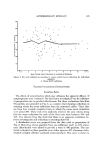
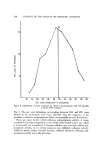
140 JOURNAL OF THE SOCIETY OF COSMETIC CHEMISTS The third type is based on gravimetric determinations of sweat output over relatively long time intervals. Procedures of this type are as a rule based on the procedure of Fredell and Read (6) and Daley (7). The procedure of this type reported by Wooding (8) presents in some detail the procedure we em- ploy. In our procedure the panelists are required to abstain from the use of all antiperspirant materials for at last one week prior to initiation of the study and throughout the study if it is a cross-over design. The sweat collections are carried out in controlled temperature rooms, 100 ---2*F and at about 35% relative humidity. Sweat collections are made during two successive 20- min periods using tared Webril©* pads. These collections are preceded by a 40-rain conditioning period in the hot room during which the panelists hold unweighed Webril pads in their axillae. In early attempts to carry out evalua- tions by this procedure, attempts were made to utilize data obtained during the periods immediately following the panelists' entry into the hot room. Ex- treme variations in sweating patterns of the panelists were encountered dur- ing the first 20-min period. Values were somewhat more reproducible during the period 20-40 min following the panelists' entry into the hot room how- ever, excessive variations in sweating patterns were still observed in some panelists. In essentially all hot room studies we have carried out during the past 10 years, sweat collections have been restricted to the period 40-80 min following panelists' entry into the hot room. We will present data which show that sweat collection data obtained during two successive 20-min collection periods, 40-60 and 60-80 minutes after hot room entry, are adequately re- producible to provide the basis for precise evaluation of antiperspirant ac- tivity. For convenience of reference, these collections will be referred to as Collections B and C. DATA EVALUATION M•.TUODS There is disagreement between investigators as to the evaluation procedure which should be applied to data obtained by various procedures. Our expe- riences indicate that the most consistent characteristic of individual sweating patterns is the ratio of sweat output by the two axillae of each individual. We have assembled sweating data from individual panelists in a series of several randomly selected studies. These studies varied from studies covering 10 days to some which encompassed 16 calendar weeks. Studies which cover longer time intervals are of multiple cross-over types. In these cases a 2-week recovery period always elapsed between test weeks. The accuracy of estimations of antiperspirant activity can be no more ac- curate than accuracy and reproducibility of data from the panelists utilized in the study. *Kendall Co., Walpole, Mass.
Purchased for the exclusive use of nofirst nolast (unknown)
From: SCC Media Library & Resource Center (library.scconline.org)