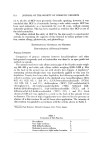
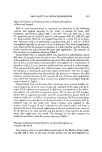
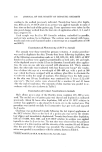
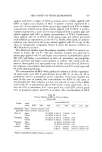
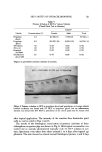
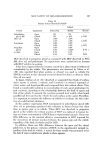
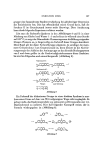
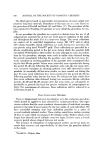
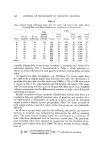
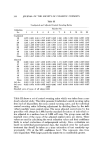
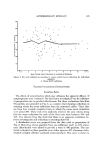
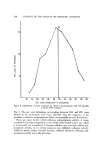
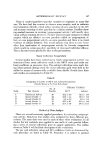
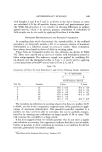
ANTIPEBSPIRANT EFFICACY 147 There is marked panelist-to-panelist variation in responses to many fac- tors. We have had the occasion to observe some samples, such as unformu- lated aluminum chloride, which reduce sweating of some panelists by 40-50% and increase sweating of other panelists by a similar amount. Panelists show- ing marked increases in sweating (properspirant activity) will usually show visual axillary irritation. However, we have observed many instances in which samples which are effective on most panelists exhibit no antiperspirant ef- fect-or even properspirant activity-on some panelists and there is no visual evidence of axillary irritation. This would indicate that there is some factor other than inactivation of antipcrspirant activity by formula components which results in certain panelists' specificity of decreased individual efficacy. This is discussed more specifically later in this presentation. Sweat Collection Temperature Several studies have been carried out in which antiperspirant activity was determined from sweat collections made in the 100øF room and under am- bient conditions on successive days. The ambient collections were made dur- ing 3-hour periods during which the sweat collection pads were held in the axillae by means of commercially available dress shields. Results from three such studies are summarized in Table IV. Table IV Comparison of Activity at 100øF and Ambient Temperature (Results Shown as Per Cent Reductions) Collection Conditions No. of Study Test Material Panelists 100øF Ambient I Commercial Roll-on - 20 32.2 ___ 6.9 32.5 ___ 9.6 2 Aerosol Powder A 24 9,3.0 ___ 4.4 9,6.0 __+ 5.0 2 Aerosol Powder B 24 8.0 __+ 3.9, 9.0 ___ 5.3 3 Aerosol Powder A 19, 25.5 ___ 8.1 9,1.0 +__ 9.2 3 Aerosol Powder B 12 27.4 ___ 7.0 9,6.6 __+ 11.0 Method o[ Data Analysis There are several commonly applied procedures for estimating antiperspi- rant activity. Data from four studies were evaluated by three different pro- cedures. The same data were used in each of these three evaluations. In all studies the test materials were applied to one axilla of each panelist follow- ing a series of control collections prior to sample application. The outline shown in Table V will facilitate description of the evaluations. The per cent reduction values and 95% confidence limits as determined by each procedure are listed in Table VI. Procedure A is subject to greatest

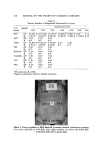
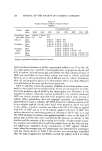
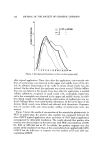
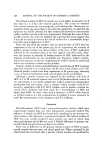
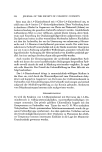
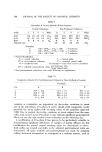
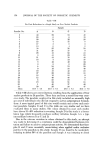
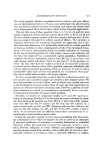
148 JOURNAL OF THE SOCIETY OF COSMETIC CHEMISTS Table V Derivation of Various Methods of Data Analysis a Control Collections Post-Treatment Collections Axilla 1 2 3 4 Mean i b 2 3 4 Mean R (T) CT CT CT CT CT•t PTT PTT PTT PTT PTT•t L (C) CU CU CU CU CU M PTU PTU PTU PTU PTUxt Ratio R R R R R•t R R R R Adiusted ratio AR AR AR AR AR M Procedure A 100 -- (PTT•/q- CT M X 100) •- % reduction B 100 -- (PTT•t .'-- PTU M X 100) = % reduction C 100 -- (AR X 100) ---- % reduction Symbol Identification. C = control collection T • treated axilla PT • post-treatment collection U = untreated control axilla R = nnadiusted ratio M subscript = mean values used in calculations AR = adjusted post-treatment ratio, post-treatment ratio mean control ratio First post-treatment co]lections were made following two applications. Table VI Comparative Results (Per Cent Reductions) Obtained in Three Methods of Analysis Procedure Test A B C 1 24.6 m 13.2 33.7 _ 3.7 30.7 --+_ 3.7 2 29.9 m 7.8 23.0 _ 5.1 21.5 +__ 4.8 3 60.6 _ 8.0 55.6 m 5.2 56.2 +__ 3.1 4 4.1 --+_ 10.4 6.1 _ 7.4 8.2 +__ 5.4 variation as evaluations are dependent on day-to-day variations in sweat rate of the individuals. Procedures B and C should yield comparable results provided the mean right-to-left sweating ratios of the panelists approach 1.000. Due to marked day-to-day variations in sweat output from the same axilla, tests carried out by Procedure A may indicate significant properspirant effects on one day and marked sweat reductions on the following day. A modification of Procedure C has proven to be particularly valuable in demonstrating significant differences of samples of similar efficacy. In this modification the normal control sweating ratios are determined as above. Both axillae are treated and shifts in the adjusted post-treatment ratios are determined. All ratios-controls and post-treatment-are made by assigning axillary treatment designations to correspond in a uniform manner, such as
Purchased for the exclusive use of nofirst nolast (unknown)
From: SCC Media Library & Resource Center (library.scconline.org)