J. Soc. Cosmet. Chem., 25, 481-494 (September 1974) A Study on the Differential Thresholds of Sensory "Firmness" and "Viscousness" of Cream Base Substances KEIJI MOROSAWA, CHIYOKO OHTAKE, MOTOJI TAKAHASHI, TAKEO MITSUI, and SEIICHI ISHIKAWA* Presented September 14, 1972, 7th IFSCC Congress, Hamburg, Germany Synopsis-The DIFFERENTIAL THRESHOLDS of sensory "FIRMNESS" and "VIS- COUSNESS" were studied. It was noted that these properties changed continuously depending upon changes in HARDNESS and VISCOSITY which were measured instru- mentally. The minimum values of differential thresholds of both firmness and viscousness were found to be about 10% and 80% level of confidence. INTRODUCTION The differential thresholds of sensory "firmness" and "viscousness" have been used to describe some of the properties of cosmetic creams which are related to their application to skin. Weber's law, which is applicable to sense properties, states that when two stimuli, S and S + AS (AS is the differential threshold in stimulus S), are given, AS/S (Weber's ratio) represents the region in which AS/S is con- stant with variance of the given stimulus. This observation has been reported for visual sensitivity (1), hearing sensitivity (2), and taste sensitivity (3). However, up until the present, there have been few reports as to touch sensi- tivity. Scott-Blair (4) investigated the threshold of firmness using vulcanized rubber ( elasticity, 1-2 x 10⁷ dyne/cm 2) and that of viscousness using bitumen (viscosity, 106-107 cps) and found that the differential threshold of firmness was % that of viscousness indicating that firmness was three times easier to *Shiseido Laboratories, 1050 Nippa-cho, Kohoku-ku, Yokohama, Japan. 481

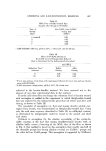
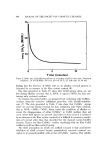
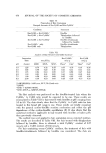
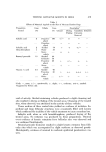
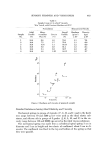
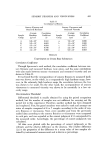
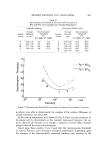
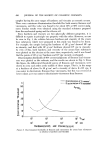
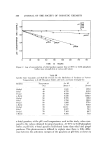
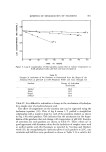
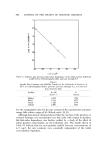
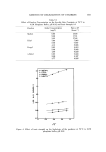
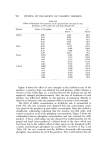
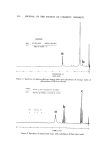
482 JOURNAL OF THE SOCIETY OF COSMETIC CHEMISTS distinguish than viscousness. In this case, the study was carried out using materials having a greater hardness and viscosity than cosmetics. It was difficult to prepare cosmetic creams for use in this study which would have a small difference in hardness and viscosity. This difference was neces- sary in order to determine the differential thresholds of firmness and viscous- ness. Therefore, the eream bases developed for this study were prepared in the same ranges of hardness and viscosity as those of cosmetic ereams by using oil and waxes which are commonly used constituents of cosmetics. The dif- ferential thresholds of sensory firmness and viscousness for the respective changes in hardness and viscosity of these samples were obtained and com- pared to the values obtained using a standard consisting of a mechanical spring and silicone oil which had the ideal elastic property and viscous prop- erty, respectively. Moreover, several experiments were carried out by using samples varying in both hardness and viscosity, and the effect of viscosity on the evaluation of firmness and the effect of hardness on the evaluation of vis- cousness. In this paper, the terms "firmness" or "viscousness" will be used to express the sensory touch xvhen the samples are applied to the skin, whereas the terms hardness or viscosity will be used to define the instrumentally mea- sured values of the samples. EXPERIMENTAL Preparation of Samples Cream Base of Given Viscoelasticity Liquid paraffin (Saybolt viscosity 70 sec) was used as the oil and solid par- affin, ceresin, and microcrystalline wax were employed as the waxes. Cream base substances with a wide range in both hardness and viscosity were pre- pared by changing the quantity of ceresin, microcrystalline wax, and liquid paraffin in the formulations. The samples were prepared in groups of five (indicated by A,B,C,D, and E ) ranging in hardness between 101 and 104 g/cm • and keeping the viscosity almost constant. In a similar manner, additional samples in groups of five were prepared (indicated by a,b,c,d, and e) ranging in viscosity between 102 and 104 cps, and keeping the hardness almost constant. The formulation for c is given in Table I, and Fig. 1 illustrates the hardness and viscosity of each of these samples. Each sample was prepared at least 6 or 7 times and good reproducibility of results was obtained as can be seen in Table I. Cosmetic creams generally have a hardness from 10 to 10 a g/'cm 2 and a viscosity of from 10 2 to 10 4 eps, as shown in Fig. 2. Compared to these figures, the eream bases used in this study were judged as having the same range of hardness and viscosity as those of commonly used cosmetic ereams.
Purchased for the exclusive use of nofirst nolast (unknown)
From: SCC Media Library & Resource Center (library.scconline.org)