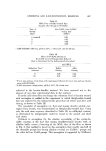
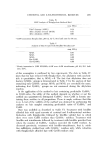
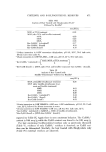
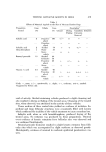
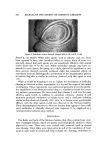
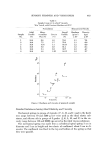
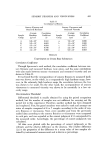
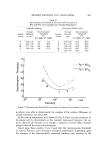
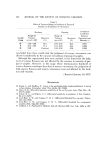
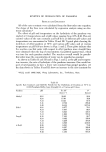
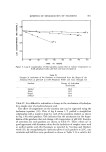
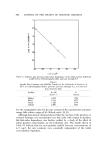
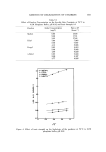
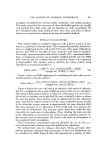
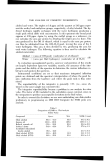
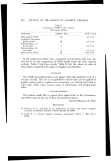
Sample No. SENSORY FIRMNESS AND VISCOUSNESS 483 Table I Sample Group (c) in which Viscosity Was Varied, with Constant Hardness at 25øC Formulation Measurement Results Sold Micro- Liquid Hardness Viscosity Paraffin crystalline Cere•in Paraffin (g/cm '•) (cps) (%) Wax (%) (%) (%) x 16' x 10'-' 10.0 8.0 4.0 '78.0 1.3 7.2 10.0 7.5 3.7 75.8 1.3 6.6 10.0 6.75 3.1 80.15 1.2 6.0 lo.o 6.0 2.6 81.4 1.2 • .3 10.0 5.3 2.0 82.7 1.2 4.7 10.0 4.6 1.25 84.15 1.2 3.7 A I 0 • •B 10 2 •-• 101 e• • 10 • 10 • 10 • cps ¾iscosit¾ Figure I. Hardness and viscosity of prepared samples Standard Substances having Ideal Elasticity and Viscosity Mechanical springs in groups of 4 grades (F, G, H, and I) and in the hard- ness range between 70 and 3200 g/cm 2 were used as the ideal elastic sub- stance, and silicone oils in groups of 5 grades (J, K, L, M, and N) in the vis- cosity range between 110 and 20000 cps served as the ideal viscous substance. The mechanical spring was made from a cylindrical spiral spring 3 cm in diameter and 3 cm in height and two sheet!•, of cardboard, about 5 cm in di- ameter. The cardboard was fixed to the top and bottom of the spring so that they were parallel.

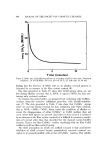
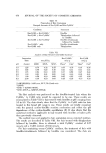
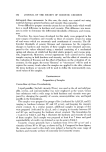
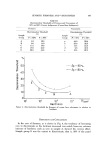
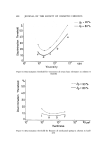
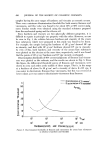
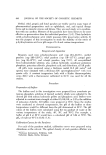
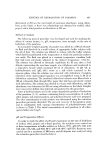
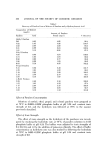
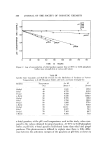
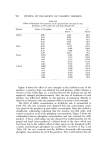
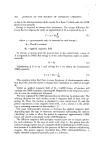
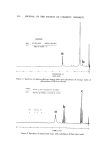
484 JOURNAL OF THE SOCIETY OF COSMETIC CHEMISTS .._.. 10 3 3:10 2 Nourishing C. ( 1 ) ß Nourmshlng C. ( 2 ) ß Nourishing C. ( 3 ) ß Cold C. (1) ß Cold C.(2) ß Cleansing C. ( 1 ) ß Cold C. ( 3 ) ß Nourishing C. ( 4 ) ß Nourishing C. (5) ß Cleansing C. ( 2 ) 10 2 10 3 10 4 Viscosity (cps) Figure 2. Hardness and viscosity of cosmetic creams Apparatus For Measuring Hardness and Viscosity Hardness was measured using a curd tension meter. In this instrument, a load is applied to the penetration rod which is fitted with a round disk (1.5- 10.0 mm in diameter) at the bottom. The hardness, expressed as grams per cm 2, is the value of the load just as the disk begins to penetrate into the sam- ple. Viscosity, expressed as cps, was measured with a Ferranti-Shirley Cone and Plate Viscometer at a shear rate of 1700 sec -• and a sweep time of 10 sec. Sensory Evaluation Sensory evaluation was carried out by trained panels of 10 subjects (5 males and 5 females each). The panel was instructed to arrange each series of sam- ples in their order according to their firmness or viscousness. This was repeat- ed 3 times by each individual. Evaluation of firmness was made by pressing the surface of the samples in the container with a finger, and viscousness was evaluated by taking out a small amount of the sample with the forefinger and applying it to the forearm. In the case of the standard, the spring was pressed down by pushing with a finger at the center of the cardboard and the resistance which is sensed when the spring is compressed 1 cm by a finger pressure was evaluated as "firm- ness," and "viscousness" of silicone oil was evaluated in a similar manner as in the case of the cream base substances.
Purchased for the exclusive use of nofirst nolast (unknown)
From: SCC Media Library & Resource Center (library.scconline.org)