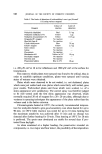
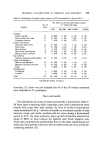
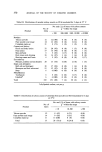
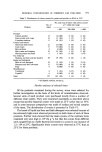
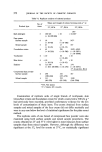
MICROBIAL CONTAMINATION OF COSMETICS AND TOILETRIES 573 difference was observed for the counts made at 25øC. The counts of anaero- bic bacteria on these units were much higher (mean count 1180 cfu g-•) than had been observed previously. Observations on packaging of the products studied The majority of products were packaged such that post-packaging contamination would not be likely to occur before the product was used. Attempts to correlate colony counts with type of packaging were unsuc- cessful. Although a few products were clearly coded, this was not evident in the majority of items examined and the absence of coding would make difficult any retrospective attempt by the manufacturer to check against the production batch if consumer complaints subsequently occurred. There were no obvious differences between colony counts from units of different size nor from small or large retail outlets. Although differences in brand gave rise to differences in the levels of contamination of particular product types it was not possible to determine the incidence of contamina- tion for any particular brand because of the small number of items examined for individual brands. DISCUSSION This survey demonstrates that in 1971 about 90• of a diverse range of cosmetic products and toiletry preparations contained fewer than 1000 viable microorganisms per g of product and that over 50•o of the items examined were essentially 'sterile'. Of those items which were contaminated, few contained more than 105 organisms g-•. The most heavily contaminated products were specific brands of eye make-up (especially liquid eyeliner), bath detergent and complete make-up. Unfortunately, tests for the presence of specific organisms such as Pseudomonas aeroginosa were not made on these products during the present investigation. From random selection of items it is not possible to determine whether the observed contamination reflects poor manufacturing conditions, post-process contamination or overlong storage by the retailer. For those products where high colony counts were observed also in the repeat examinations it is probable that the high colony counts reflect poor manufacturing conditions. Tests to assess whether these products might have become spoiled by growth of the contaminating organisms was not undertaken, but other workers (4, 5)

574 JOURNAL OF THE SOCIETY OF COSMETIC CHEMISTS have demonstrated that deterioration can occur in products which are inadequately preserved. The incidence of significantly contaminated samples (i.e. containing 300 cfu g-X) in the present investigation is similar to the levels previously reported from the U.S.A. Wolven and Levenstein (16) reported an incidence of contamination of 24.4• (61 out of 250 items examined) whilst Dunnigan and Evans (17) observed contamination in 33 (19.5•o) out of 165 items of cosmetic examined. Unfortunately, although the latter workers identified the predominant microflora they gave no information of the nature of the contaminated products. More recently, Wolven and Levenstein (18) have shown a much lower incidence of contamination of cosmetic products in the U.S.A., only eight (3.5•o) of 223 items examined being contaminated. It is not unreasonable to suppose that similar improvements in the quality of cosmetics may have occurred during the past two years in the U.K. In particular, awareness of the need to ensure good microbiological quality in raw materials, especially natural pigments and fillers, will have had an effect on the levels of microorganisms present in many products (D. Spooner, personal communication). In devising any 'Code of Good Manufacturing Practice' the absence of specific pathogens must be considered in addition to control of the overall level of microbial contamination of the product. When complete product sterility is not feasible, cosmetic and toiletry preparations should be free from viable pathogens such as Pseudomonas aeroginosa, salmonellae, Escherichia coli, Staphylococcus aureus and certain clostridia. Raw materials of mineral origin, such as talc, may be contaminated with spores of soil clostridia including CI. tetani (19) and Cl. perfringens. Whilst C1. tetani contamination of talc is known to have caused at least one outbreak of tetanus in babies (9, 19) the significance of C1. perfringens spores is less clear. Strains of C1. perfringens are known to cause gas gangrene in man and animals, the route of entry to the body tissues being via wounds and abrasions in the skin (20). However, the minimum infective dose of CI. perfringens strains is probably considerably above the level at which any area of skin would become contaminated by a cosmetic preparation containing a relatively low number of spores per gram. ACKNOWLEDGMENTS The authors are indebted to the Select Committee of the Toilet Prepara- tion Federation and the Society of Cosmetic Chemists of Great Britain for
Purchased for the exclusive use of nofirst nolast (unknown)
From: SCC Media Library & Resource Center (library.scconline.org)