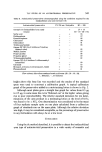
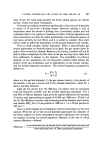
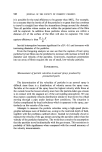
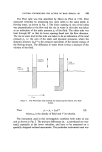
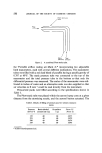
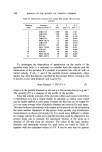
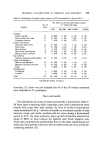
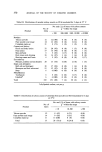
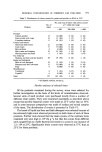
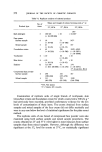
524 JOURNAL OF THE SOCIETY OF COSMETIC CHEMISTS changes in the weather. In order to ascertain whether there are significant differences between hand lotions, the statistical analysis must take account of differences between subjects in their mean hand scores and also the differences between the two weekly hand scoring sessions. In an analysis of variance, each of the six sequences of hand lotion usage was analysed as a randomized block experiment with some missing observations, subjects corresponding to blocks and scoring sessions to treatments. The treatment means which are given by this analysis are the scoring session means cor- rected for differences between subjects. They contain information on differences between lotions as well as between sessions. These results were then analysed as a generalized latin square experiment, sequences corre- sponding to rows, sessions to columns and lotions to treatments. The treatment means which are given by this analysis are the overall mean hand scores for each lotion corrected for differences between subjects and for differences between scoring sessions. RESULTS Effect of normal humectants on isolated corneum In the first series of experiments, the effect of a number of humectants on the water holding capacity and extensibility of solvent-damaged guinea pig footpad corneum was investigated. Table I shows the effect of immersing the corneum for 30 min in 5•o aqueous solutions of glycerol, sorbitol, sodium lactate and the sodium salt of 5-pyrollidone-2-carboxylic acid (NaPCA). Glycerol and sorbitol are commonly used humectants in skin creams. NaPCA (14) and lactate (5) are important constituents of the natural hygroscopic material in intact corneum. In each experiment, the effects of the humectant solution were compared with those of water on a number of replicate pairs of corneum pieces. The table indicates where there were statistically significant differences between the effects of humectant and water, as assessed by analysis of variance. All the humectants increased the extensibility of corneum under these conditions. With the exception of sorbitol, they also significantly increased the water holding capacity. Table H shows the effect, in a different series of experiments, of immers- ing the treated corneum in water. Solvent-damaged corneum was immersed in 5•o solutions of the humectants for 30 min, followed by immersion in water for 30 min. Control pieces of corneum were immersed in water for two successive periods of 30 min.

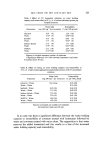
SKIN CREAM FOR DRY AND FLAKY SKIN 525 Table I. Effect of 5• humectant solutions on water holding capacity and extensibility at 81% r.h. of solvent-damaged guinea pig footpad corneum Water held Extensibility Humectant (mg 100 mg -x dry corneum) (% per 100 g load) Glycerol 19.9 (9) 1.24 (10) Water 17.4' (9) 0.60* (10) Sorbitol 18.6 (8) 0.82 (8) Water 17.5 (8) 0.53* (8) Sodium lactate 21.6 (9) 1.71 (20) Water 17.8' (9) 0.43* (20) NaPCA 23.3 (10) 2.07 (10) Water 17.5' (10) 0.54* (10) Figures in brackets represent number of replicates. * Significant difference (P 0.05) between humectant and water. Treatment times 30 min. Table II. Effect of rinsing on water holding capacity and extensibility at 81 • r.h. of solvent-damaged guinea pig footpad corneum with 5 % humectant solutions Treatment Water held Extensibility (mg 100 mg -• dry corneum) (% per 100 g load) Glycerol: Water Not done 0.76 (20) Water: Water 0.76 (20) Sorbitol: Water 16.5 (10) 0.44 (10) Water: Water 17.1 (10) 0.42 (10) Sodium lactate: Water 17.2 (18) 0.48 (30) Water: Water 17.5 (18) 0.41 (30) NaPCA: Water 15.6 (10) 0.33 (10) Water: Water 15.5 (10) 0.41 (10) Figures in brackets are numbers of replicates. All treatment times were 30 min. In no case was there a significant difference between the water holding capacity or extensibility of corneum treated with humectant followed by water and corneum treated with water alone. The supposition is that water removes the added humectant and this results in a loss of the increased water holding capacity and extensibility.
Purchased for the exclusive use of nofirst nolast (unknown)
From: SCC Media Library & Resource Center (library.scconline.org)