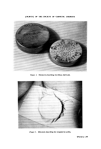
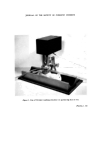
J. Soc. Cosmet. Chem. 26 17-28 (1975) ¸ 1975 Society of Cosmetic Chemists of Great Britain Evaluation of antiperspirant preparations under normal conditions of use M. W. STEED* Presented on 13th November 1973 in Nottingham, at the Sym- posium on 'Evaluation of Product Performance', organized by the Society of Cosmetic Chemists of Great Britain. Synopsis--A method of assessing the effectiveness of ANTIPERSPIRANT agents under normal or near normal conditions of use has been developed. SILICA GEL moisture absorbing tins strapped to the body side of the AXILLA are used for SWEAT collection, and the change in ratio of sweat produced between axillae for a subject, when only one axilla is treated, is taken as a measure of antiperspirant effect. The advantage of the ratio method is that it eliminates the need for controlled conditions. Using three ALUMINIUM CHLORHYDRATE preparations, significant individual and group sweat reductions have been recorded. It has also been observed that the individual response to these preparations varies consider- ably from one subject to another. INTRODUCTION The primary function of an antiperspirant preparation is to reduce the rate of perspiration flow in the axilla. Progress in developing effective antiperspirants is, however, limited by the lack of a reliable in vivo method of assessing their action under normal conditions of use. There has been much literature published on the measurement of perspiration flow, but many of the methods have practical drawbacks. Basically there are three * Reckitt & Colman Toiletry Division. 17

18 JOURNAL OF THE SOCIETY OF COSMETIC CHEMISTS types of published method, visual or colorimetric, continuous humidity assessment and gravimetric. The basis of the colorimetric method is to apply an anhydrous indicator to the skin and to observe the extent of colour formation, when sweat is produced. A developer may also be used to produce the colour, which is usually in the form of individual dots, each dot corresponding to a sweat gland. The disadvantage of this type of method is that it is not readily quantitative, and that it is only applicable to flat, accessable areas of the body such as the back or fore-arm. Many workers have studied the colori- metric approach and Daley (1) has produced a quantitative method that has given good agreement with other methods. It did, however, require a large area of skin such as the back, and depended on a numerical count of dots, not taking into account their size or intensity. The continuous humidity approach is almost the opposite to the gravi- metric in that it is readily suited to axillary sweating measurement, and is fully quantitative. It depends on directly measuring the humidity of the air in a cell held in the axilla, and sophisticated adaptions produced by workers such as James (2) are capable of giving a direct print out on an x-y recorder of the sweating ratio between axillae. The objection to the method is that the subject is severely restricted in movement, and adaptation to normal conditions of use is not really feasible. Most attention in recent years has been directed at gravimetric methods of assessing perspiration flow, as they are direct or absolute and reasonably convenient. Much of the early work in this field was conducted by Fredell and co-workers (3, 4). Their method was to use pre-weighed absorbent pads held in place in the axilla without a harness for a fixed period of time. The increase in weight of the pad was a measure of degree of perspiration. The daily variation of weight of sweat produced by individuals was found to be high, but the ratio of sweat produced from one axilla to the other for an individual was reasonably constant. If after a control period only one axilla was treated, the change in ratio was a measure of antiperspirant effect. It was necessary with this sweat collection technique, however, that the subjects were static, and a hot room to induce perspiration was required. This method is the basis of the procedure used by Hill Top Research Inc., and typical results obtained using this procedure have been published by Martin (5). The great advantage of using the change in ratio as a measure of antiperspirant effectiveness is that it is independent of the absolute weight of sweat collected, which can vary considerably even under fairly controlled conditions.
Purchased for the exclusive use of nofirst nolast (unknown)
From: SCC Media Library & Resource Center (library.scconline.org)