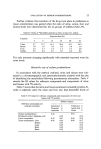
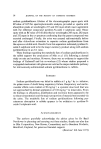
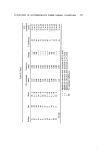
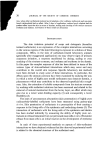
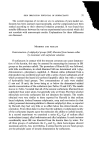
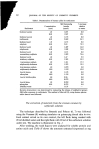
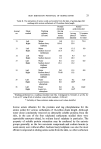
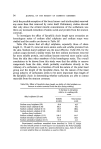
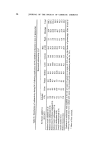
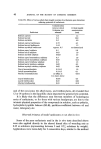
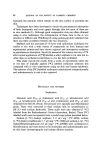
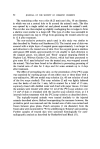
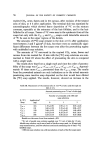
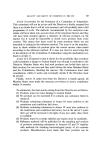
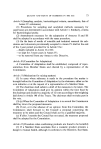
SKIN IRRITATION POTENTIAL OF SURFACTANTS 39 many others for the study of specific histamine-releasing agents (14), and full details are to be published elsewhere (15). There was always a very low level of spontaneous histamine release from the mast cells on incubation (generally less than 10•o) in the absence of surfactants. However, as the concentration of surfactant was increased, a level was reached when there was rapid release of the stored histamine (up to 85•o of the total). Further increase in the concentration of surfactant did not release more. The relationship between a series of surfactants, all with a 12-carbon lipophilic chain, but with a variety of polar headgroups, and histamine-releasing potential is shown in Table VI. Sodium lauryl Table VI. The ability of 12-carbon chain length surfactants of various polar head groups to release histamine from rat mast cells in vitro Surfactant Concentration Critical micelle (mM) at which concentration in histamine was buffer at 22 ø released (mM) Lauryl alcohol No effect at 1 m•a Water insoluble Lauryl monoethoxylate 0.2-0.5 0.1 Lauryl triethoxylate 0.03 0.03 Lauryl hexaethoxylate 0.02-0.05 0.035 Sodium lauryl sulphate 0.03 1.0 Sodium lauryl mono- ethoxy sulphate 0.05 0.15 Sodium lauryl tri- ethoxy sulphate 0.05 0.2 Sodium laurate 0.4 10.0 Sodium lauroyl isethionate 0.15 1.2 sulphate and its mono- and triethoxy derivatives were the most potent anionic surfactants, and lauryl tri- and hexaethoxylates (non-ionic surfac- tants) were equally as effective at similar concentrations. However, sodium laurate and sodium lauroyl isethionate were far less potent by almost an order of magnitude. For the anionic surfactants the concentrations to cause mast cell degranulation (i.e. histamine release) were consistently below the critical micelle concentration (CMC). The effect of chain lengths of different surfactants upon histamine release was studied and shown in Table VII. Of the anionic surfactants the series of alkyl soaps, alkoyl isethionates, alkyl sulphates and ether sulphates

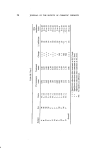
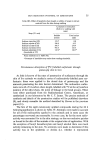
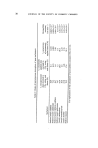
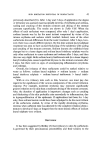
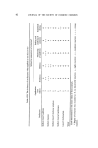
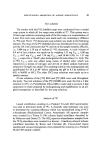
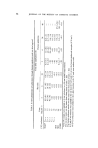
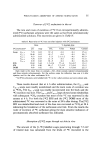
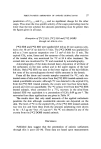
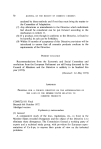
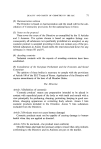
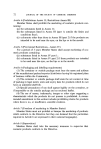
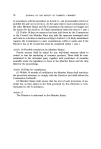
40 JOURNAL OF THE SOCIETY OF COSMETIC CHEMISTS Table VII. Effect of various alkyl chain length moieties of surfactants upon histamine releasing potential of surfactants Surfactant Concentration (raM) at which Critical micelie histamine was concentration released (mM) Sodium caprate Sodium laurate Sodium myristate Sodium caproyl isethionate Sodium lauroyl isethionate Sodium myristoyl isethionate Sodium capryl sulphate Sodium lauryl sulphate Sodium myristyl sulphate Sodium capryl monoethoxy sulphate Sodium lauryl monoethoxy sulphate Sodium capryl triethoxy sulphate Sodium lauryl triethoxy sulphate Sodium myristyl triethoxy sulphate Capryl monoethoxylate Lauryl monoethoxylate Myristyl monoethoxylate Capryl triethoxylate Lauryl triethoxylate Myristyl triethoxylate 1.0 1.3 O.4 10.0 0.5 6.0 0.75 6.5 0.15 1.2 approx. 0.5 not determined 0.5 9.0 0.03 1.0 0.025 2.5 0.5 1.0 0.05 0.15 0.2 1.5 0.05 0.2 0.02 0.06 0.2-0.5 1.0 0.2-0.5 0.1 no effect at 0.013 0.1, insol. above 0.075 0.8 0.03 0.03 0.03 0.18 and of the non-ionics the alkyl mono- and triethoxylates, all revealed that 12 or 14 carbons in the lipophilic chain imparted the greatest lytic potential. It is likely that the differences seen between members of homologous series of surfactants, or for those with various headgroups, are due to the intrinsic physical properties of the compounds in solution, such as polarity, hydrophilic-lyophilic balance (HLB), partition-coefficient between oil and water, detergency etc. Observed irritancy of model surfactants to rat skin in vivo Some of the pure surfactants used in the in vitro tests described above were also applied directly to the shaved dorsal skin of weanling rats as 0.25 M solutions (representing between 5 and 10•o solutions by weight). Applications were twice daily for 3 consecutive days, similar to the method
Purchased for the exclusive use of nofirst nolast (unknown)
From: SCC Media Library & Resource Center (library.scconline.org)