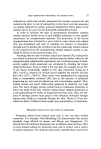
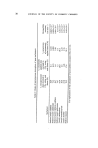
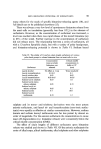
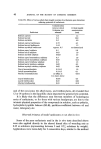
SKIN IRRITATION POTENTIAL OF SURFACTANTS 45 extraction, penetrability and cell-lytic ability. The concentration of sur- factant used is most important, below the critical micelle concentration, when the surfactant behaves as an ideal solution, denaturation and extrac- tion of the corneum is not so important. This suggests that adequate know- ledge of the physical chemistry and solution thermodynamics of surfactants is vital to an understanding of how surfactants may invoke a skin response. The studies reported here suggest that no one experimental procedure can adequately replace that in which surfactants are directly applied to the backs of animals, and the skin's response is assessed by the naked eye. If one wishes to compile a mathematical equation for skin irritancy, this must necessarily be a complex function, and more than just an expression of penetration and cell toxicity. One must also include expressions governing the binding of surfactants to skin, the modification of the stratum corneum which allows greater penetration, the polarity of the surfactants involved, etc. Thus, when one attempts to employ laboratory methods dealing with various parameters of the skin's response to surfactants, one must clearly define the questions being asked by such tests. For example, knowledge of the effect of surfactants upon living cells would have no value in evaluating whether a surfactant formulation had a drying effect upon the stratum corneum, whereas studies on extraction ability would. On the other hand, substantivity and knowledge of penetrability through the skin would be important in deducing whether a compound was able to cause erythema. The data described above do not permit us to state which type of laboratory test would be the most adequate to give an indication of whether a surfactant is potentially irritant to the skin, rather, we have shown that there are many parameters of the response to be considered, each playing a specific part in the overall phenomenon of skin-surfactant interactions. Similar conclusions have been drawn by Brown (17). (Received: 22nd May 1974) REFERENCES (1) Middleton, J. D. The mechanism of action of surfactants on the water binding properties of isolated stratum corneum. J. $oc. Cosmet. Chem. 20 399 (1969). (2) Blank, I. H. Factors which influence the water content of the stratum corneum. J. Invest. Derrnatol. 18 433 (1952). (3) Bettley, F. R. The irritant effect of detergents. Trans. St. John's Hosp. Derrnatol. $oc. 58 65 (1972).

46 JOURNAL OF THE SOCIETY OF COSMETIC CHEMISTS (4) Zweifach, B. W., Grant, L. and McCluskey, R. T. The Inflammatory Process (1965) (Academic Press, New York and London). (5) Harrold, S. P. Denaturation of epidermal keratin by surface active agents. J. Invest. Dertnatol. 32 581 (1959). (6) Smeenk, G. and Polano, M.K. Methods for comparative estimation of the irritancy of various detergents on human skin. Trans. St. John's Hosp. Dermatol. Soc. 51 220 (1965). (7) Smeenk, G. The influence of detergents on the skin (a clinical and biochemical study). Arch. Klin. Exp. Dermatol. 235 180 (1969). (8) Vermeer, D. J. H., de Jong, J. C., Donk, L. and Leemhuis, J. Een onderzoek naar de werking van wasmiddelen op de huid. Ned. Tijdschr. Geneesk. 107 1768 (1963). (9) Prottey, C., Ferguson, T. F. M. and James, C. T. The percutaneous absorption of some pure surfactants. In preparation. (10) Scala, J., McOsker, D. E. and Relier, H. H. The percutaneous absorption of ionic sur- factants. J. Invest. Dermatol. 50 371 (1968). (11) Howes, D. The percutaneous absorption of some anionic surfactants. J. Soc. Cosmet. Chem. 26 47 (1975). (12) Friske-Holmberg, M. On the mechanism of chlorpromazine-induced histamine release from rat mast cells. Acta Physiol. Scand. 83 412 (1971). (13) Bloom, G. D. and Haegermark, O. Studies on morphological changes and histamine re- lease induced by bee venom, n-decylamine and hypertonic solutions in rat peritoneal mast cells. Acta Physiol. Scand. 71 257 (1967). (14) Uvnas, B. Mast cells and inflammation. In: Inflammation biochemistry and drug inter- action Ed. by E. BetteIll and J. C. Houck (1969) (Excerpta Medica Foundation, Amsterdam). (15) Ferguson, T. F. M. and Protrey, C. The effect of surfactants on living cells in vitro. In preparation. (16) Prottey, C., Hattop, P. J. and Ferguson, T. F. M. The effect of soap upon certain aspects of skin biochemistry. J. Soc. Cosmet. Chem. 24 473 (1973). (17) Brown, V. K. H. A comparison of predictive irritation tests with surfactants on human and animal skin. J. Soc. Cosmet. Chem. 22 11 (1971).
Purchased for the exclusive use of nofirst nolast (unknown)
From: SCC Media Library & Resource Center (library.scconline.org)