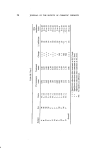
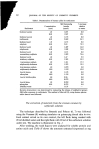
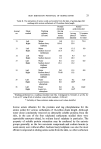
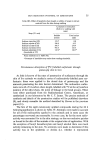
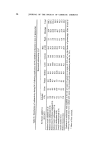
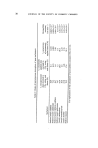
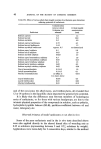
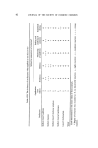
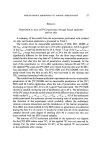
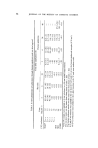
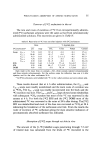
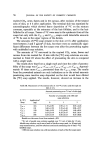
SKIN IRRITATION POTENTIAL OF SURFACTANTS 43 living cells of the skin, and so two of the laboratory methods we have employed deal specifically with percutaneous absorption and effect upon living cells (mast cells) in order to investigate this suggestion. In addition, we have included experiments designed to study the effect of surfactants upon the horny layer (namely, denaturation of keratin and extraction of corneum components), for, as the results in Table VIII show, the overall response of rat skin to exaggerated treatment with surfactant solutions is comprised of responses in the stratum corneum as well as in the living cells beneath. We attempted to use the data from the various experimental procedures (Tables I-VII) to predict the irritation potential of surfactants. For example, Table VI shows both lauryl triethoxylate and sodium lauryl sulphate to be equally potent as histamine-releasing agents upon mast cells, but as the former compound had a permeability constant of almost two orders of magnitude greater than the latter, we would have expected the nonionic triethoxylate to be far more irritant to the skin than the alkyl sulphate. Table VIII shows that this is not the case, however. Lauryl tri- ethoxylate invoked no skin response after repeated cutaneous application, whereas after 3 days sodium lauryl sulphate had a pronounced effect, both in terms of denaturation of keratin and in extraction of proteins and amino acids. This would suggest that in defining an experimental approach to enable one to predict irritancy, one must consider other aspects of skin- surfactant interactions than merely penetration and effect upon the living skin cells. The results in Table VIII show that the overall skin reponse to the five surfactants may be ranked in decreasing order of magnitude: sodium lauryl sulphate sodium laurate sodium lauryl triethoxy sulphate sodium lauroyl isethionate • lauryl triethoxylate. However, when the various tables (I-VII) listing data from the experimental methods are examined, nowhere may one find a similar ranking of skin response to these surfac- rants, and, as such, must throw doubt upon the usefulness of these ap- proaches for evaluating irritation potential of surfactants. We would suggest the following reasons for these differences. Firstly, the conditions necessary for the full response to develop (Table VIII) were repeated application twice daily, for 3 consecutive days, and not merely a single application. Using the Vermeer washing simulator we have found that if the washing procedure was repeated daily for several days on guinea-pigs, surfactants such as sodium lauryl sulphate continued to extract more components than, say, sodium laurate, and so cumulative action of surfactants would affect the skin's ability to replace quickly and

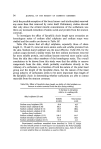
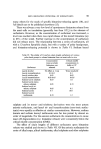
44 JOURNAL OF THE SOCIETY OF COSMETIC CHEMISTS fully natural moisturizer etc. removed during this washing. Equally, the fact that we have found some surfactants denature keratin or modify the stratum corneum suggests that the skin may be sufficiently altered after one application to behave quite differently during subsequent applications. Although sodium lauryl sulphate has a very low rate of penetration (per- meability constant of 0.065 x 10 -6 cm min -•) it is probable that if the animals had been previously washed with this surfactant prior to application of the radioactive compound, sufficient changes in the stratum corncure may have occurred to allow greater amounts to be absorbed. This has certainly been shown to be true for sodium lauroyl isethionate. Table V gives a permea- bility constant of 0.3 x 10 -6 cm min -•. When additional guinea-pigs were washed three times with this surfactant on the day prior to the penetration study we found that the average value of the permeability coefficient was 0.92 x 10 -6 cm min -•. Thus, frequency of treatment has a direct bearing on observed penetrability. This would suggest that laboratory methods designed to examine individual aspects of the skin's response to surfactants should be designed to resemble normal methods of application of these compounds. Secondly, in the present study we have examined by no means all of the salient parameters of skin-surfactant interaction. Middleton (1) showed that the amount of lipid extracted from stratum corncure was dependent upon the type of surfactant used, and its removal affected the water-binding capacity and the flexibility of the skin. We have not as yet studied lipid removal by model surfactants. It may well be that this aspect is more important than, say, removal of proteins and amino acids from the stratum corneum. Indeed, the stability of the skin's lipid mantle during washing and its subsequent rate of recovery may be a rate-limiting factor. Equally, we have no precise data on substantivity. If a seemingly non-penetrating sur- factant actually tightly binds to the stratum corncure this may in practice leave a large cutaneous pool which gradually penetrates during many hours after a single exposure, and so overall irritation potential would be greater than first thought. Also, we have not considered partition coefficients of the sttrfactants used: it is possible that solubility in the components of the skin (lipids, aqueous phase) is important to overall irritancy. Each of the four approaches dealing with individual aspects of overall skin-surfactant interactions we have described, indicate that the chemical structure of surfactants is very important in determining its effect upon the skin. Head-group polarity determines whether a surfactant can denature protein, extract compounds from the stratum comeurn and penetrate to the living cells. Also, the length of the lipophilic chain imparts properties of
Purchased for the exclusive use of nofirst nolast (unknown)
From: SCC Media Library & Resource Center (library.scconline.org)