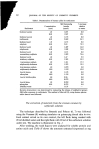
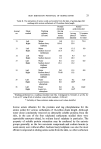
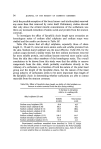
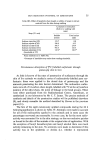
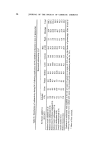
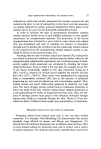
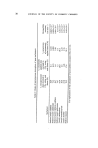
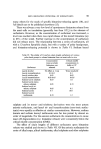
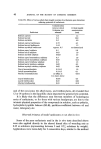
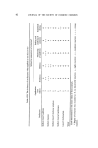
PERCUTANEOUS ABSORPTION OF ANIONIC SURFACTANTS 61 The SDI penetration in vivo was below our limits of accurate measure- ment in this study, i.e. 0.3 gg cm -2 penetrated from a 15 min wash and rinse. Small amounts of •4CO•. were detected frpm the topically treated animals (approximately 10 cpm above background) which indicated that small amounts (0.1-0.2 I, tg cm -•) did penetrate in vivo. Subsequent experi- ments with [•4C] SDI with a specific activity of 17.6 gCi mg 4 have confirmed that small amounts (0.09 gg cm -2 from a 15 rain application of a 10 m•t solution) did penetrate from this type of application. The penetration of the DOBS isomer was below our limits of detection (0.1 gg cm -•) for all experiments. This is probably due to the very low solubility of this isomer (•----0.3 mM at 37 ø) which although present in com- mercial dodecylbenzene sulphonate, is not typical of DOBS. The 3.0 mM suspension used in the topical studies at 37 ø was below the critical micellar concentration of this DOBS isomer. Thus the in vivo studies show that all of these [•C] surfactants penetrate rat skin with the exception of the [•C] DOBS, the solubility of which was very low. From the in vivo penetration data presented, it can be seen that there is an order of magnitude difference between the most penetrating of the soaps (Cx•: 0-0.6 gg cm -•) and the least penetrating (C18: 0-0.07 gg cm -•) when applied as 6 mu solutions. The penetration of the synthetic surfac- tants from 25 mM solutions showed that some 0.25 pg of SDS and 0.15 gg of SDI penetrated per cm a of skin. Thus, provided a linear relationship between the amount penetrating and concentration of these surfactants in the applied solution exists, then the C•: 0 soap is about ten times as pene- trating as SDS or SDI which penetrate at similar rates to the C•8: 0 soap. Autoradiography of the treated skins from the 15 min wash and rinse applications showed deposition of surfactant on the skin surface and in the hair follicles especially at their entrances. This deposition suggests that penetration occurs both transepidermally and via the hair follicles which have been regarded as the main source of penetration for applications of short duration (16, 17). The presence of •C in the epidermis and upper dermis at 6 h after application of the C•o: 0 and Cx•.: 0 soaps shows the penetration of these soaps but gives no indication when they penetrated. Penetration may have occurred only during the 15 min washing time but penetration may also have taken place from the labelled soap deposited on the skin surface. The fact that the rate at which •CO2 was recovered from the animals washed with C•: 0 soap was slightly slower than from animals injected with C•: 0 soap may be a reflection of the route of administration

62 JOURNAL OF THE SOCIETY OF COSMETIC CHEMISTS but is probably due to the fact that penetration occurs from the [14C] soap deposited on the skin. This experiment is the first of a series on the percutaneous absorption of surfactants and shows that although the in vitro systems give some useful data on relative penetrations they do not completely reflect the in vivo situation and extrapolation from in vitro to the user conditions is difficult. The in vivo experiments in this study have not examined the relationships between penetration and the concentration of the applied solution, duration of contact or number of applications. The 15 min applications in this study were an exaggerated 'consumer type' application but a range of contact times from 1 to 20 min with four different concentrations of surfactant are being examined and the effects of multiple application of test solution. It is felt that this type of in vivo study gives data which can be related to human use of all types of products coming into contact with skin. ACKNOWLEDGMENTS I would like to thank Mr C. T. James for the synthesis of the x4C labelled synthetic surfactants used in this study and Mrs A. Cordell for skilful technical assistance. (Received: 1st April 1974) REFERENCES (1) Tregear, R. T. Physical functions of skin, 1 (1966) (Academic Press, London). (2) Wahlberg, J. E. Percutaneous absorption of trivalent and hexavalent chromium (*•Cr through excised human and guinea-pig skin. Dermatologica 141 288 (1970). (3) Maibach, H. I., Feldman, R. J., Milby, T. H. and Serat, W. F. Regional variations in percutaneous penetration in man. Pesticides. Arch. Environ. Health 23 208 (1971). (4) Feldman, R. J. and Maibach, H. I. Regional variations in percutaneous absorption of •4C-cortisol in man. J. Invest. Dermatol. 48 181 (1967). (5) Bartek, M. J., Labudde, J. A. and Maibach, H. I. Skin permeability in vivo: comparison in rat, rabbit, pig and man. J. Invest. Dermatol. 58 114 (1972). (6) Sprott, W. E. Surfactants and percutaneous absorption. Trans. St. Johns Hosp. Dermatol. Soc. 51 56 (1965). (7) Patterson, M. S. and Green, R. C. Measurement of low energy beta emitters in aqueous solution by liquid scintillation counting of emulsions. Anal. Biochem. 1 279 (1960). (8) Bruno, G. A. and Christian, J. E. Determination of carbon-14 in aqueous bicarbonate solutions by liquid scintillation techniques. Anal. Chem. 35 1216 (1961).
Purchased for the exclusive use of nofirst nolast (unknown)
From: SCC Media Library & Resource Center (library.scconline.org)