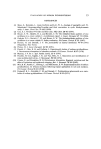
PERCUTANEOUS ABSORPTION OF ANIONIC SURFACTANTS 63 (9) (10) (1•) (12) (13) (14) (15) (16) (17) Ainsworth, M. Methods for measuring percutaneous absorption. J. $oc. Cosmet. Chem. 11 69 (1960). Noakes, D. N. and Sanderson, D. M. A method for determining the dermal toxicity of pesticides. Brit. J. btd. Med. 26 59 (1969). Rutherford, T. and Black, J. G. The use of autoradiography to study the Iocalisation of germicides in skin. Brit. J. Dermatol. 81 Supplement 4 75 (1969). Blank, 1. and Gould, R. Penetration of anionic surfactants into skin 1. Penetration of sodium laurate and sodium dodecyl sulphate into excised human skin. J. htvest. Dermatol. 33 327 (1959). Bettley, F. R. The irritant effect of soap in relation to epidermal permeability. Brit. J. Dermatol. 75 113 (1963). Scala, J., McOsker, D. E. and Relier, H. H. The percutaneous absorption of Ionic Sur- factants. J. Invest. Dermatol. 50 371 (1968). Black, J. G. and Howes, D. Percutaneous absorption of Irgasan DP 300 from toilet pre- parations. Paper presented at the VIIIth International Congress of the International Federation of Societies of Cosmetic Chemists, August, 1974. Sheuplein, R. J. and Blank, I. H. Permeability of the Skin. Physiol. Rev. 51 702 (1971). Grasso, P. Some aspects of the role of skin appendages in percutaneous absorption J. Soc. Cosmet. Chem. 22 523 (1971).

J. Soc. Cosmet. Chem. 26 65-74 (1975) ¸ 1975 Society of Cosmetic Chetnists of Great Britain Implications of the enlarged European Economic Community on the quality and safety of' cosmetics and toiletries D. M. GABRIEL* Presented on 29th August 1974 in London at the IFSCC VIIIth International Congress on 'Cosmetics--Quality and Safety' organized by the Society of Cosmetic Chemists of Great Britain. Synopsis--Prior to the enlargement of the EEC in January 1973, when Britain, Denmark and Ireland joined, there was already some activity relating to the Cosmetic and Toiletry Industry. A proposal for a 'Directive on the Approximation of the LAWS of Member States relating to Cosmetic Products', based on a negative, a restricted and a provisional list was being prepared. A Technical Study Group of Government experts had been formed to draw up the lists and a group of analysts assembled to recommend analytical methods to monitor the materials in the restricted and provisional lists. UK Government and Industrial representatives were included in these Groups and in addition a Microbiological group has been set up. Several amendments to the draft Directive have been suggested and it is not likely to become law until 1975. There is a strong move by most member states towards a POSITIVE LIST but this could not be implemented for at least 5 years because of the immense difficulties which will have to be overcome. In any case, the implications are that all companies manufacturing goods which come within the scope of the Directlye will have to ensure that all their products offered for sale conform to the legislation. Details of the various lists and the proposed reference methods of analysis and control together with their implementation will be discussed. In Britain, we have now become accustomed to the fact that we belong to the EEC but the implications as they relate to this industry are not always appreciated. * Unilever Research, Isleworth Laboratory, 455 London Road, Isleworth, Middlesex TW7 5A B 65
Purchased for the exclusive use of nofirst nolast (unknown)
From: SCC Media Library & Resource Center (library.scconline.org)