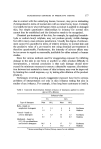
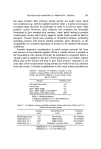
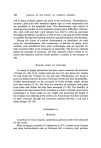
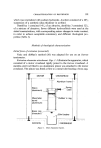
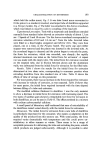
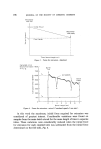
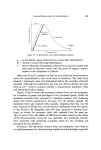
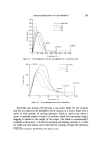
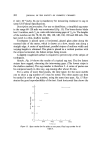
CHARACTERIZATION OF DENTIFRICES 201 90 f ::"' 80 -- 5cm/min i ........ I0 70 : '• -- -- -- 20 :t •o i i*• ................ •o • !l.t: ß ,,:.., ./ • 5o s-rector s-foctor ,o '"• .......... i ...... s-foctor 0 I'0 2'0 3.0 4'0 5.0 6'0 7.0 8.0 Extension cm Figure 11. Force-distance curve for carragheenan A in sorbitol syrup. •oo 200 I00 0 0 -rvl---c--g - -.•... x • m/min - _ :" F/".. '• '•. I ß . ...•....• ß ....,..•... ........................ ! .0 2-0 3.0 4,0 .5.0 Extension crn F/g.r• •2. Por½½-distan½½ ½ur¾½ for a dcntioeric½. Reynolds and Larsen (33) devised a sag index blade for the purpose and this was improved by Schaeffer (32). It consists of a doctor blade with a series of wide notches of varying clearance which is used to lay down a series of parallel stripes of paint of uniform width but increasing height. Sagging is related to the height of the stripe. The blade is commercially* available in three sizes: 1-6 mils for spraying and dipping enamels, 3-12 mils for trade sale type paints and 14-60 mils for coatings of high film thickness * The Leneta Company, Ho-Ho-Kus, New Jersey, U.S.A.

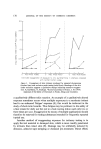
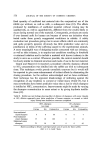
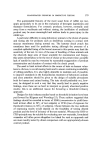
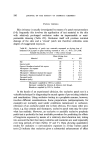
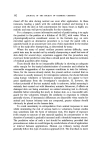
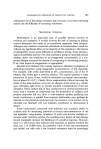
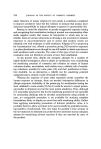
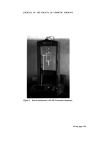
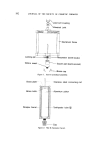
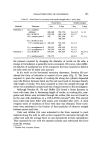
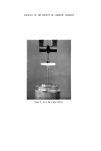
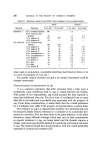
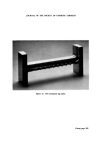
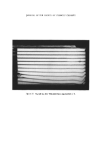
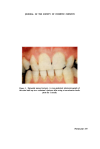
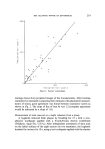
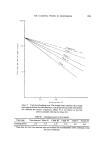
2O2 JOURNAL OF THE SOCIETY OF COSMETIC CHEMISTS (1 mil = 10 -a inch). Its use is mandatory for measuring resistance to sag in some US Federal Specifications. Description andprocedure. For use on dentifrices, a simplified sag meter in the range 60-120 mils was constructed (Fig. 13). The brass doctor blade has 11 notches, each 1/4 in. wide with intervening gaps of 1/16 in. The heights of the notches are 60, 70, 80, 90, 100, 120, 140, 160, 180 and 200 mils. The last notch is a thin, shallow marker. Toothpaste is placed upon a horizontal, glazed glass plate along the recessed side of the meter, which is drawn at a slow, steady rate along a straight edge. A series of equidistant, parallel stripes of uniform width and varying heights is obtained. The plate is placed in a vertical position with the stripes horizontal, the fattest stripes being lowest. A slightly roughened surface is required to prevent slip of the stripes of toothpaste. Results. Fig. 14 shows the results of a typical sag test. The five fattest stripes have sagged, obscuring the intervening gaps. (The lowest stripe is the shallow marker.) The sag number is therefore 5. A series of pastes can be compared easily in this way, sag ceasing after about 30 min. For a series of more fluid pastes, the time taken for the most mobile one to show a sag number of 1 may be noted. The other pastes can then be ranked in order of sag number, using the same time span. Fig. 15 illus- strates the good reproducibility of the test. Each horizontal line shows the I o I 200 I 400 Time (s) I I I 600 I 800 Figure 15. Span results for five trials on one paste. Final sag number for all trials 5.
Purchased for the exclusive use of nofirst nolast (unknown)
From: SCC Media Library & Resource Center (library.scconline.org)