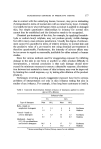
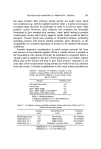
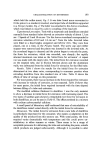
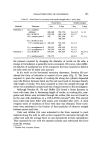
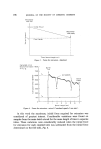
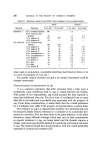
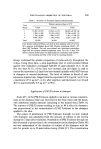
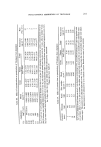
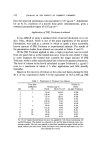
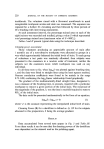
PERCUTANEOUS ABSORPTION OF TRICLOSAN Table I. Turnover of Triclosan injected subcutaneously 209 Time Tritium recovery (dpm x 10 4) (days) Urine Faeces Total l 17.487 •:5.079 23.210-26.112 40.697:3_8.722 (4) 2 3.5894-1.303 12.1554-4.011 15.7444-6.041 (3) 3 1.126 4- 0.840 2.289 • 1.037 3.415 4-1.149 (2) 4 0.857 4-0.611 1.170 4-0.610 2.027 4-1.021 (2) Total 23.059 38.824 61.883 Four female Colworth-Wistar rats (120 g) were injected with 0.5 ml of a 50% aqueous polyethylene glycol 400 solution containing 69.453 x 10 • dpm [aH] Triclosan. The rats were placed into individual metabolism cages and the excreta collected separately every 24 h for 4 days. The tritium content of the faeces was determined by combustion and scintilla- tion counting and that of the urine by counting directly. always contained the greater proportion of radio-activity throughout the 4 days. Using these data, a semi-logarithmic plot of total excreted tritium against time indicated a biological half-life of approximately 14 h. In the first two days 81.3•o of the dose was excreted, and this figure is used to correct the recoveries in 2 days from rats treated topically with [all] Triclosan in shampoo or aerosol deodorant. The level of tritium in blood of sub- cutaneous-injected rats ranged from the equivalent of 0.2 [tg ml 4 at 0.5 h to a maximum of 5.2 [tg ml 4, at 6 h after injection and decreased over 24 and 48 h to approximately 0.3 [xg ml 4 at 96 h. Application of [all] Triclosan in shampoo Some 855/0 of the [all] Triclosan applied to rat skin at various concentra- tions in the shampoo base was recovered in the rinse water and the patch, with additional smaller amounts remaining in the treated skin (Table II). The amount of [all] Triclosan residing in skin, at 48 h after the shampoo, was proportional to the concentration of [all] Triclosan in the shampoo applied to the skin. The extent of penetration of [all] Triclosan through rat skin washed with shampoo was calculated from the amount of tritium in the excreta during the 2 days after treatment. Penetration of [all] Triclosan through rat skin increased in proportion to the concentration in the shampoo (Table III) but was independent of the duration of contact of the shampoo with the skin for periods up to 20 min before rinsing (Table IV). The concentration

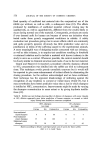
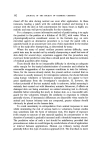
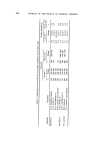
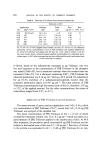
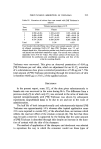
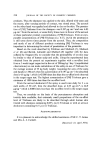
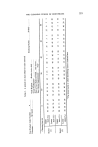
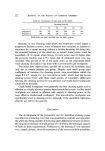
210 JOURNAL OF THE SOCIETY OF COSMETIC CHEMISTS Table II. Recovery of Triclosan from shampoo-treated rats Recovery at 48 h Application Rinsings Patch Skin Rats (%) (Bg/7.5 cm 2) (Bg) (Bg) (•g cm -2) (No. of 0.05 89 (15 cm 2) 76.5+5.6 1.0 0.15 12 0.10 103 93.7+1.7 2.8+0.6 0.48 3 0.50 474 410 +63 7.4+3.4 1.40 3 0.75 671 563 •38 6.6+4.6 1.75 8 1.0 880 879 +51 18.6+3.4 2.40 3 2.0 1664 1717 +65.6 26.9-4-7.9 3.24 3 To 7.5 cm • (or 15 cm 2) clipped dorsal female rat skin, 0.1 ml (or 0.2 ml) shampoo containing various concentrations (w/v) of [all] Triclosan was applied followed by 0.1 ml (or 0.2 ml) H•O and spread over the skin for 1 min. After a further 9 rain the rats were rinsed, dried, a protective patch applied and transferred to individual meta- bolism cages. At 48 h after treatment the rats were killed and the patch and treated area of skin removed for analysis. in blood, based on the radioactivity expressed as [tg Triclosan, was very low and increased as the concentration of [alii Triclosan in the shampoo was raised (Table III), but it remained constant when the contact time was increased (Table IV). For a shampoo containing 0.055/0 [all] Triclosan the observed penetration was 0.16 [tg cm -2 during a 48 h period. On adjustment for an 81.3•o excretion of a subcutaneously-injected, known dose the corrected penetration figure is 0.197 [tg cm -2. The total amount of [alii Triclosan penetrating through the treated area of skin is, therefore, 2.95 [tg, or 3.3•o of the applied amount. For the other concentrations, the extent of penetration ranged from 2.8• to 4.1•. Application of [all] Triclosan in aerosol deodorai7t The mean amount of spray used per application was 1.454_-0.36 g which at a concentration of [all] Triclosan of 0.13/o meant that 1.45•0.36 mg [all] Triclosan was sprayed at the shielded rats. The mean concentration of [aH] Triclosan in the 1 x 15 cm • of shield around the treatment window was 13.24-6.2 [tg cm -• which was taken as a good measure of [aH] Triclosan applied to the treated area of skin. At 48 h after treatment, the protective patch contained 41 [tg [all] Triclosan and the residue in the treated area of skin was 9.74-4.8 [tg cm -•. Recovery of tritium in the excreta was equivalent to 41.7•_ 11.48 [tg [alii Triclosan for six rats,
Purchased for the exclusive use of nofirst nolast (unknown)
From: SCC Media Library & Resource Center (library.scconline.org)