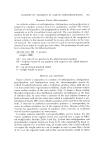
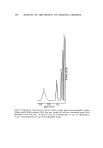
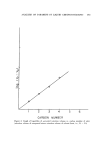
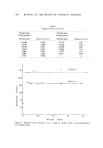
378 JOURNAL OF THE SOCIETY OF COSMETIC CHEMISTS stances commonly found in the complex matrices of many foods, drugs, and cosmetics and quantitation can be performed analogously to gas chromato- graphic methods. Despite its increasing use, relatively few papers have been reported concerning routine quantitative analysis for ingredients in cosmetics. This paper describes a simple and reliable HPLC method using a reversed phase-packing material for quantitating individual parabens in cosmetic emulsions or suspensions with a liquid chromatographic apparatus construc- ed from available components. Several significant advantages accompany this approach. Primary among these is the low cost and reliability of the instru- mentation involved. Most articles published on quantitative HPLC techniques have employed expensive instruments and high pressures (greater than 1000 psig) to achieve adequate separations. Our experience has shown that many analyses can be performed at reasonable pressures (500 psig or less) with low cost components available from various suppliers and assembled in the lab- oratory. The expense involved in purchasing and operating most commercial instruments precludes their exclusive use for a particular quantitative analy- sis. For paraben analyses specifically, a reversed phase chromatographic sys- tem eliminates potential losses due to reduced solubility of the higher paraben homologs in the aequeous ion exchange system described by Nelson (6). Ease of sample handling and analysis time (less than 30 min per ample) compare favorably with other methods commonly in use (7), and the technique de- scribed is applicable to a wide variety of formulations containing parabens. EXPERIMENTAL Apparatus An HPL chromatograph shown in Fig. 1 was assembled as follows. The sol- vent delivery system was a Milton Roy Minipump,©* Model 196-31, capable of operation at pressures up to 1000 psig. Connected in sequential order froin the pump outlet were a Chromatronix©* pressure relief valve, a 1000 psig pressure gauge, and a 6 ft x 0.03 in. inside diameter (i.d.) length of Teflon© tub- ing, whose function was to minimize pulsations caused by the reciprocating delivery of solvent from the pump. A subsequent modification has re- placed the tnbing with a bellows-type pluse dampers to improve baseline stability. A 30 x 0.2-cm i.d. glass column packed with Vydac©0 reversed phase *Milton Roy Company, 5000 Park St. N., St. Petersburg, Fla. 33733. *Chromatronix, Division of Spectra Physics, 2905 Stender Way, Santa Clara, Calif. 95050. -*Laboratory Data Control, P.O. Box 10235, Interstate Industrial Park, Riv- iera Beach, Fla. 33404. 0Separations Group, 8738 Oakwood Street, Hesperia, Calif. 92345.

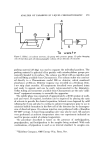
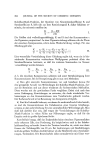
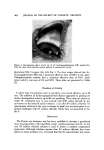
ANALYSIS OF PARABENS BY LIQUID CHROMATOGRAPHY 379 1 ' ,/' 3 4 5 7 To wasfe Figure I. HPLC: (1) solvent reservoir (2) pump with pressure gauge (3) pulse damping coil (4) injection port (5) chromatographic column (6) uv detector (7) recorder packing material (37-44/•) was used to separate the individual parabens. The packing material is spherical silica particle with octadecylsilane groups per- manently bonded to its surface. The column was fitted with an injection port and end fitting available from Chromatronix. The column outlet was connect- ed directly to a Chromatronix model 200 uv detector, which monitored absorbance at 254 nm. Detector response was recorded on a Beckman 10-in. 1-mv strip chart recorder. All components described were purchased intact and ready to operate and can be easily interconnected in the laboratory. Teflon tubing and connectors available from Chromatronix are the only "addi- tional" equipment necessary to assemble the apparatus. The mobile phase was comprised of approximately a 20:80 mixture of meth- anol and water. If required, resolution can be improved by altering the ratio of solvents to provide the desired separation. Solvents were degassed by mild refluxing for 5 min and also by cooling to ambient temperature prior to use to minimize bubble formation in the flow cell of the detector due to decompres- sion of dissolved gases. On-column injection was performed with a Hamilton HP 305* syringe. A closed loop-sampling valve may also be used. All analyses were performed at ambient tempcrature since our experiments indicated no need for precise control of column temperature. The procedure described is based on the presence of methylparaben, propylparaben, and butylparaben in the samples being analyzed. With such combinations, ethylparaben is used as an internal standard. In samples con- *Hamilton Company, 4960 Energy Way, Reno, Nev.
Purchased for the exclusive use of nofirst nolast (unknown)
From: SCC Media Library & Resource Center (library.scconline.org)