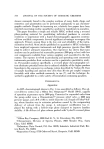
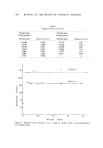
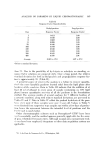
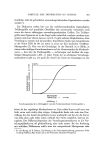
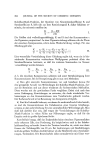
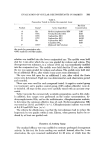
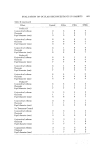
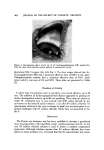
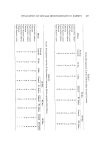
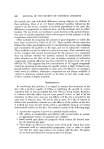
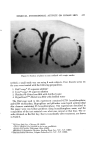
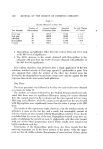
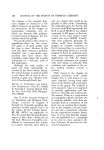
384 JOURNAL OF THE SOCIETY OF COSMETIC CHEMISTS Table I Response Factor Linearity Weight Ratio Weight Ratio Methylparaben Propylparaben -Ethylparaben Response Factor Ethylparaben Response Factor 0.1603 0.942 0.1701 1.06 0.2566 0.920 0.3402 1.09 0.5131 0.912 0.4552 1.09 0.6414 0.933 0.8504 1.04 1.283 0.921 1.2756 1.10 1.924 0.922 2.125 1.07 4.791 0.892 -- -- 1.10 1.00 t_ .90 o .8o o .70 .1C .,. PROPY L METHYL i 0 .50 1.0 1.5 9.0 Wei9h'f Ra-I'io Figure 4. Response factor ]inearity over a range of weight ratios: (X) propylparaben (O) methylparaben

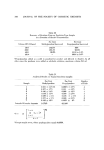
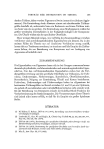
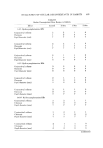
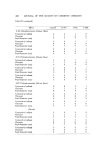
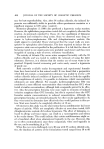
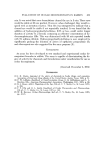
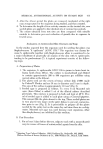
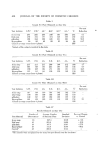
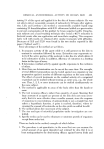
ANALYSIS OF PARABENS BY LIQUID CHROMATOGRAPHY 385 Table II Response Factor Reproducibility Methylparaben Propylparab en Day Response Factor Response Factor 1 0.911 1.06 3 0.910 1.08 8 0.908 1.06 11 0.889 1.08 58 O.94O 1.08 308 0.945 1.08 336 0.910 1.05 353 0.935 1.06 398 0.941 1.06 400 0.936 1.04 Average 0.923 _+_ 2%a 1.07 _+_ 2% a aRelative standard deviation. •han 3% Due to the possibility of hy, l:vlysis or solvolysis on standing, re- sponse factor solutions are prepared daily. Over a long period, the relative s•andard deviation for both m?thylparaben and propylparaben response fac- tors is approximately 3% (Table II). A potential source of error in the analysis is a failure to recover quantita- tivel,• the more lipophilie parabens beyond ethyl from the lipid phase after b•'eak n•, of the emuls on. Data in Table III indicate that the addition of at least 40 ml of ethanol to every gram of sample (containing ca. 10% lipid phase) insures quantitative recovery of all the parabens in the formulations stud ed. The average results of several analyses for 7 different batches of a cosmetic emulsion, along with relative standard deviations, are presented in Tables IV and V. Data in Tab!e IV reflect the gradual hydrolysis of the para- borts s nee most of these samples were over i year old. Values in Table V were obl-ained from suspension-type samples run within a few days of produe- tion, hence the agreement between the intended level of parabens and the level f•nnd is much better. Other ehromatographie columns such as Permaphase• ETH • have been "::ed successfully, and the method appears generally applicable for the assay of p2ra-substituted benzoate esters. Although manual area measurement teeh- n:c'ues have been employed, integrators or other data acquisition systems are applicable. *E. I. du Pont de Nemours & Co., Wilmington, Del.
Purchased for the exclusive use of nofirst nolast (unknown)
From: SCC Media Library & Resource Center (library.scconline.org)