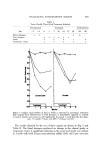
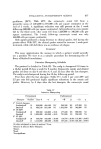
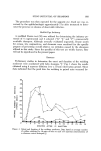
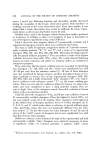
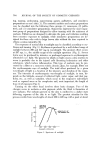
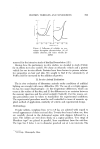
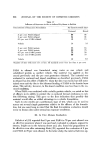
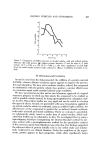
STING POTENTIAL OF SHAMPOOS 585 The procedure was then repeated for the opposite eye. Each eye was ex- amined by the ophthalmologist approximately i hr after treatment to deter- mine the presence or absence of observable irritation. Rabbit Eye Irritancy A modified Draize test (10) was utilized for determining the irritancy po- tential of 8 experimental and 3 selected ("B," "J," and "P") commercially available shampoos. Although normally evaluated separately, Draize scores for cornea, iris, conjunctivae, and chemosis were combined for the specific purpose of presenting overall relative eye irritation caused by the shampoos utilized in this study. Since the specifics of this test are widely known, they will not be reproduced in the present paper. RESULTS Preliminary studies to determine the onset and duration of the writhing syndrome were conducted with baby shampoo "J." Fig. 1 shows the results obtained using 4 aqueous dilutions over a 15-rain observation period. These data indicated that the peak time for writhing in paired mice occurred be- 50- 45- 8% 4o_ •5- .I Figure 1. Outset and duration of the writhing syndrome. Data based on average number of writhes exhibited by 10 pairs of mice at each of 4 aqueous concentrations of a reference control shampoo (J)

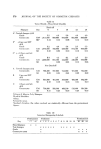
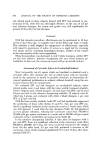
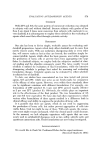
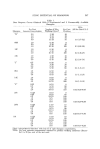
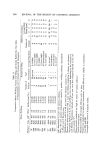
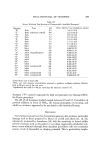
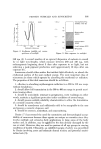
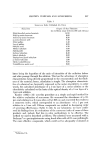
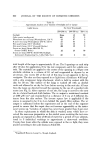
586 JOURNAL OF THE SOCIETY OF COSMETIC CHEMISTS tween 1 and 6 min following injection and, thereafter, steadily decreased during the remainder of the 15-min observation period. Peak incidence of writhing occurred at the $-min observation time. From these studies, it •vas judged that a 6-min .observation time would be sufficient for future experi- ments where an all-or-none observation was to be used. Distilled water, used as the shampoo vehicle during these studies, produced no incidences of writhing or other overt symptoms of pain or discomfort in any of 10 separate experiments using a total of 20 mice. Table I shows the dose/response effects of 3 commercially available and 8 experimental shampoos using the all-or-none method of observation. The data in Table II represent comparative studies of 3 selected commer- cially available products ("B," "J," and "P") and a series of 8 experimental shampoos (08B, 14F, 14G, 08A, 14E, 25S, 25M, 101) being developed specifi- cally for special mildness properties. • They are ranked in order of the highest (mildest) to lowest (least mild) WD,o values. The results obtained following human eye-sting evaluation and rabbit eye irritation studies are included for comparison purposes. These data show that the mouse writhing test was successful in identifying four shampoos ("P," 25S, 25M, and 101 ), which were significantly less mild (P-• 95 per cent) than the reference control (J). All four of these shampoos were also considered by human testers to produce the highest degree of eye- sting (moderate to severe). Five of the experimental shampoos (08B, 14F, 14G, 08A, 14E) and a single commercial "baby" shampoo ("B"), were equiva- lent in mildness to the reference control ("J") via the mouse writhing pro- cedure. These six were also the mildest as judged by human eye-sting evalu- ations and were considered to have a sting potential ranging from ab- sent to slight. None of the shampoos caused observable irritation in human testers at the concentrations studied. Table III shows the comparative WD5o and 95 per cent confidence limits of 21 commercially available shampoos. When the highest to lowest WD.•o val- ues were ranked, nearly all of the leading "baby" shampoos tested appeared in the mildest class of shampoo products. Seven of 9 baby shampoos (B, N, U, S, K, G, and V), which make claims or inference of special mildness prop- erties, had WD5o values that were not statistically different from the refer- ence control, "J." On the other hand, two baby shampoos (G and H) and all eleven of the "adult" variety of shampoos tested were significantly less mild than the reference baby shampoo. Rabbit eye irritaney scores indicated all eight of the experimental and both commercially available "baby" shampoos were relatively innocuous in terms of significant, visible eye irritation potential. A popular "adult" variety øResearch and Development, Avon Products, Inc., Suffern, New York 10901.
Purchased for the exclusive use of nofirst nolast (unknown)
From: SCC Media Library & Resource Center (library.scconline.org)