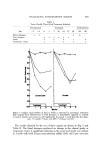
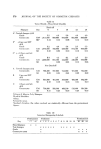
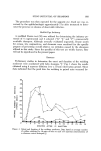
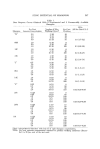
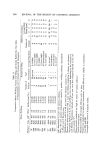
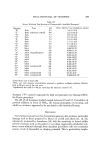
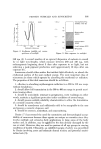
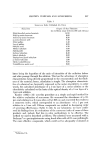
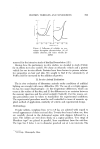
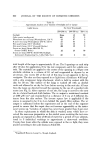
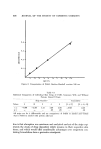
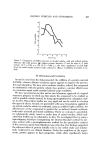
PROTEIN VEHICLES AND SUNSCREENS 605 placed in a 1.5 x 12.5 cm test tube containing 5 ml of 0.1 N sodium hydroxide for elution of PABA. Each sample was eluted on a Vortex* mixer for 1 min at the fastest mixing rate. Recoveries indicated that a l-rain elution was sufficient to remove as much as 10 gg of drug. PABA was assayed by the Bratton- Marshall method (2õ). 5. Procedure for Recoverq of PABA from Blenderin tape: Various amounts of PABA in 0.1 N sodium hydroxide were added to 9,1/2 x 7 cm strips of Blen- derin tape for a calibrated syringe. The solvent was allowed to evaporate in a hood and the strips extracted as mentioned previously. Skin blanks obtained on 20 strips gave an average absorbance of 0.007 in the Bratton-Marshall test. All subsequent absorbency reading were blank corrected. B. Results and Discussion Standard curves for PABA are given in Fig. 6, whereas the recovery of drug from tape are given in Table V. Overall recovery of PABA by the elution of the tapes with 0.1 N sodium hydroxide was 99 per cent. In earlier studies on PABA, the recoveries, which occurred during the use of an alcoholic vehicle, were low due to the dissolution of the tape adhesive, which after evaporation, trapped drug in the glue-adhesive matrix. Recoveries of PABA were consider- ably improved by the use of concentrated alcoholic solutions, which were di- luted with chloroform. Small volumes of chloroform applied to the tapes eva- Dorated rapidly, thereby preventing the drug from dissolving into the tape acl- hesive. Recoveries under these conditions were quantitative. The statistical analysis of PABA in the presence and absence of protein is given in Table VI. The data represented in Fig. 7 are the average amounts of the drug found in 5 subjects per group distributed over 50 skin strips per group. As indicated in Fig. 7 and Table VI, strips 4 and 5 with 5 degrees of freedom show significance at the 95 per cent level. The significance at such high levels for small sample numbers lends credence to the enhanced sub- stantivity and/or penetration effect of the protein. From these data, the prob- ability exists that if considerably more samples were obtained and the tech- niques of assay, application, and removal of stripped skin were better stan- dardized, the variance would be reduced considerably, which in effect could show significant differences over many more stripped areas than were found here. Our animal studies with uv-induced erythema in rabbits shows that PABA sunscreens prepared with 2 per cent protein gel on rinsed sites gave enhanced substantivity over similar formulations lacking the protein vehicle. Although these studies are preliminary, the protein curve shown in Fig. 7 would seem to indicate that protein produces a retardation of penetration pos- sibly by adsorption to certain acidic molecular sized fragments. The implica- *Scientific Products, New York, N.Y.

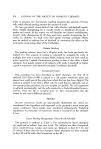
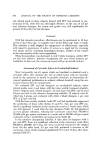
606 JOURNAL OF THE SOCIETY OF COSMETIC CHEMISTS '- . ,, qi • • % •, q• I, .I .2 3 .4 .$ .6 .7 .8 .9 1.0 •G/mL Figure 6. Concentration of PABA. Bratton-Marshall reaction 540 nm Table VI Statistical Comparison of Individual Skin Strips of PABA Sunscreen With and Without Protein: Paired T-Tests Strip Number a Cumulative Values I 2 3 4 5 [1 q- 2] [3 n t- 4 n t- 5] t = --0.86 --1.05 1.11 3.56 3.09 --0.95 2.35 p .... .05 .05 -- .10 gall strips are for 4 differentials and are comparisons of PABA in alcohol and United State's PABA in alcohol with protein adjuvant. tion is that absorption was maximum and analytical analysis of the strips rep• resents the strata of drag deposited, which remains in their respective skin tissue, and which would offer considerable advantages over nonprotein con- taining formulations from a protective standpoint.
Purchased for the exclusive use of nofirst nolast (unknown)
From: SCC Media Library & Resource Center (library.scconline.org)