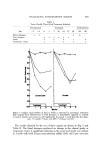
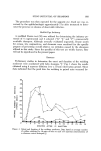
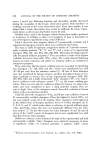
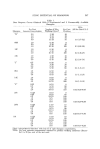
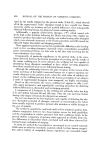
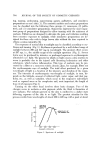
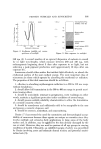
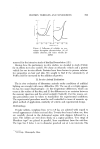
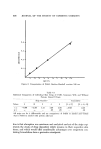
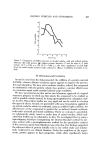
PROTEIN VEHICLES AND SUNSCREENS 595 lOO • 8o • 60 bJ e 40 .c bJ • 20 FAR 250 400 MIDDLE NEAR I • $00 550 Wavelength in Millimicrons Figure 2. Erythema (middle uv) versus spectrum of sunlight -4hrs- -5- -2- -1- I I- Total Erythemal Flux % II 57500EBurnBlistering 70- •- - /• 24000 50- • - Poinful Sunburn 50- • 12000 ••i - Vivid Erythema 6000 10- •_ MPE 5000 Figure 3. Skin response to sunlight 340 mF (4). A second reaction of an upward dispersion of melanin is caused by uv light wavelengths, which measure between 280 and 310 m,tz , with melanogenesis beginning about 2 days after exposure to uv light, but not achieving a peak pigment production until approximately 19 days after sun exposure (6). Sunscreens should either scatter the incident light effectively or absorb the crythermal portion of the sun's radiant energy. The most important class of sunscreens are those which operate by absorbing the erythemal uv radiation. The properties of the ideal sunscreen should be as follows: 1. effective in absorbing erythemogenic radiation in a 280 to 315 nm range without breakdown 2. should allow full transmission in the 300 to 400 nm range to permit maxi- mum tanning effect 3. should be nonvolatile, resistant to perspiration, resist washings-in other words, maintain a significant protection under conditions of normal usage 4. should possess suitable solubility characteristics to allow the formulation of a suitable cosmetic vehicle 5. should be nonodorous and sufficiently mild to be acceptable to the user and possess a cosmetic elegance and 6. should be nontoxic, nonirritant, and nonsensitizing. Draize (7) has stressed the need for nontoxicity and dermatological accep- tability of sunscreens because these agents are unique as cosmetics since they involve multiple and extensive daily applications to large areas of the body surface and, in addition, may be applied to the skin already damaged by the sun or wind. Moreover, they are used on persons of all age groups in varying conditions of health. Ultimately, an eightfold margin of safety was prescribed by Draize involving acute and subacute derma] toxicity and potential sensiti- zation tests (8).

596 JOURNAL OF THE SOCIETY OF COSMETIC CHEMISTS Among the ideal characteristics listed previously for a sunscreen prepara- tion, probably the xnost sought after attribute is nonwashability. Sunscreen preparations, by virtue of their use, are applied to the body preceding swim- ming or excessive exercise in which perspiration tends to. wash off or dilute any material on the skin. Therefore, it is desirable, in order to avoid multiple applications, to find a sunscreen formulation, which in addition to protecting the user from erythemogenic rays of the sun and permitting tanning, can also be applied infrequently and which will remain on the skin even after continu- ous exposure to water via swimming, perspiration, or bathing. The term used to describe the binding of a sunscreen agent to the skin is often referred to as "substantivity," a specific term referring to the capacity of an agent to adhere or combine with keratinized substrates. PABA is found to be absorbed by the intact epidermis, which results in partial chemical con- jugation with the constituents of the horny layer and results finally in a sub- stantive property of this specific sunscreen agent. Willis and Klingman (9) termed a compound truly substantive when the horny layer reservior was full (resulting in a substantive compound remaining fixed through physical or chemical conjugation.) Pathak et al (10) found that an ethanolic solution of PABA at pH 4.5 to 4.8 was substantive to the horny layer even after repeated washings with water. Others have not found this substantive property to be true under normal use conditions. The purpose of this presentation is to review how we approached the problem of evaluating sunscreen agents by developing the appropriate technology to allow us to determine significant performance improvements of some sample formulations and to investigate substantive properties on human skin. The sequence of test procedure we developed was as follows: (1) in vitro evaluation (2) in vivo (animal) eval- uation and (3) in vivo (human) evaluation. EXPERI/vlENTAL EVALAUTION I. In Vitro Evaluation Testing for the effectiveness of a sunscreening preparation begins with the uv-spectrophotometric evaluation to determine the absorption range and ca- pacities. These may be expressed as E-vitrons (11), a sunscreen index (12), a K value (13), or any one of the in vitro terminologies that provide for spectro- photometric comparisons to be made of a sample sunscreen agent to a known standard (14). In the formulation of sunscreen preparations, it is necessary to assess the efficiency both of the sunscreen and the prototype products. This was done by examining the absorption characteristics spectrophotometrically in terms of concentration, thickness of liquid through which the light passes, and wave- length. The absorption characteristics may be expressed as a percentage of the incident radiation absorbed or transmitted, or as the optical density with the
Purchased for the exclusive use of nofirst nolast (unknown)
From: SCC Media Library & Resource Center (library.scconline.org)